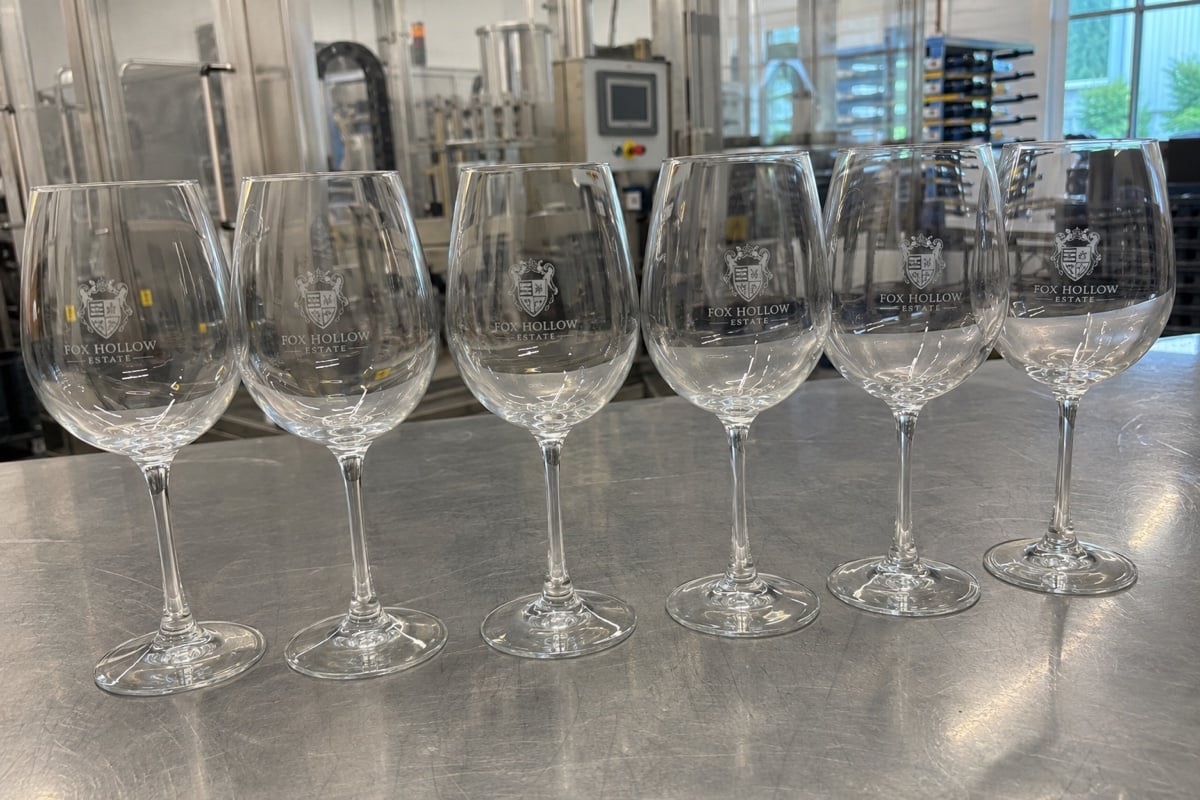
A wine-by-the-glass program lives or dies on a number most people never measure: how much wine actually leaves the bottle with each pour. The menu math assumes a clean, consistent serving, but the glass on the bar does not know what the spreadsheet expects. An etched pour line is the cheapest way to make the physical pour agree with the plan, and understanding why starts with what a standard pour really is.
What a standard pour actually is
In the United States, the five-ounce pour (about 150 ml) is the de facto standard for wine by the glass, and it exists for a practical reason: a 750 ml bottle holds roughly 25.4 ounces, so five-ounce servings divide it into a tidy five glasses. Other measures are common elsewhere and for different purposes. The UK’s small legal measure of 125 ml yields six glasses, its 175 ml measure yields four, and a large 250 ml pour gets you three. Tasting flights run smaller still, often two to three ounces so a guest can sample several wines. The point is that the pour size is a business decision, not an accident, and every ounce is accounted for in the price on the menu.
Servings per 750 ml bottle at common pour sizes; the 5 oz US standard yields five glasses.
Because the bottle is a fixed 25.4 ounces, the relationship between pour size and yield is unforgiving. There is no rounding in your favor. If your menu is priced around five glasses per bottle and your pours drift larger, the missing servings come straight out of margin.
Why a free-poured line drifts
Ask three bartenders to pour a “glass of wine” by eye and you will get three different volumes, and all of them tend to creep upward during a busy shift. Generosity feels like good service, and a splash extra is invisible in the moment. The trouble is what that splash does across a whole bottle. Move from an intended five-ounce pour to six ounces and the yield falls from about 5.1 servings to roughly 4.2 per bottle. That is nearly a full glass of unsold wine given away from every single bottle, and it compounds across every bottle, every night. On a wine list where by-the-glass pour cost is already targeted higher than bottle sales, usually in the 20 to 28 percent range to absorb spoilage and waste, an untracked overpour is the difference between a healthy program and one that quietly bleeds.
Yield drops steeply with pour size: a one-ounce overpour costs almost a full serving per bottle.
The waste is not only in the overpour. A re-corked bottle stays acceptably fresh for only about five days, so a program that runs a few extra ounces per pour also empties bottles faster than the sales justify and pushes more partial bottles toward oxidation and the drain. Consistency at the glass is what keeps the whole system honest.
What an etched pour line does
An etched pour line is a permanent mark fired or abraded into the glass at the intended fill height, so the server pours to the line instead of to a feeling. It removes the guesswork without slowing service, and unlike a painted or printed mark it does not wash off, scratch away, or fade through hundreds of commercial dishwasher cycles. Glasses like this already exist as a product category for exactly this reason, and having them custom-etched lets you set the line at your own house pour rather than someone else’s. The line does double duty: it standardizes the serving for cost control, and it makes training new staff trivial, because “pour to the line” is a rule anyone can follow on their first shift.
Specifying pour-line glasses for a venue
A few decisions determine whether the glasses work the way you want. First, decide the fill volume and where it sits in the glass. A five-ounce line should land well below the widest point of the bowl so wine has room to breathe and swirl; that means the glass itself needs meaningfully more capacity than the pour, which is why a five-ounce pour typically lives in a bowl of twelve ounces or more. Choosing a bowl that is too small forces the line uncomfortably high and makes a standard pour look stingy. Second, decide whether you want a single line or several. A single house-pour line is cleanest for a bar with one wine serving; a venue running both a standard glass and a tasting pour may want two discreet marks. Third, decide how visible the line should be: a subtle frosted band reads as understated and upscale, while a more defined line is faster to hit under low bar lighting. Finally, treat the line like any other decoration and confirm the etching method is rated for commercial dishwashing, since the whole value proposition depends on it surviving years of service.
When pour lines earn their keep
Etched lines make the most sense wherever consistency and cost control matter more than a purely decorative glass. High-volume by-the-glass bars are the obvious case, because small per-pour differences scale into real money. Hotels and banquet operations benefit because they run large teams and temporary staff who need to pour identically without supervision. Tasting rooms and flight programs use lines to keep sample pours honest and comparable. Even a single busy restaurant can justify them purely on the training and consistency they buy. The glass still carries your branding and still looks the part on the table; it simply also tells the person holding the bottle exactly where to stop. For a program built on pouring the same wine hundreds of times a week, that little line is one of the highest-return details you can specify.
For a home dinner party, glass is the obvious choice for wine. For a pool deck, a stadium suite, a beachfront wedding, or a busy tasting room that runs everything through a commercial dishwasher forty times a day, the real question is whether the glass should be glass at all. A dropped stem is not just a replacement cost; it is a safety hazard near bare feet and a service interruption at the worst moment. That is why shatterproof stemware has become standard for so many venues, and why the material you pick matters more than the shape. Four plastics dominate the category, and they behave very differently once you look past the word “unbreakable.”
Why venues move off glass in the first place
The case for plastic is rarely about saving a few cents per unit. It is about eliminating breakage in environments where broken glass is unacceptable or outright banned. Many pools, marinas, outdoor festivals, and municipal event spaces prohibit glass entirely, which takes the decision out of your hands. Even where glass is allowed, high-turnover service creates a steady breakage rate that a shatterproof glass simply removes, along with the labor of sweeping up and the liability of a shard in a service lane. A branded reusable plastic wine glass also travels better: it survives shipping to an off-site event, stacks without chipping, and comes home in the same condition it left. The tradeoff is that no plastic looks and feels exactly like fine crystal, and each type gives up something different to get its durability.
The four materials, and what each gives up
Tritan copolyester is the closest thing to a default for premium reusable stemware. It combines glass-like clarity with genuine impact resistance, it is BPA-free and food-contact safe, and its usable temperature range runs from about −40°C up to roughly 109°C, with an enhanced grade rated higher still. Those numbers matter because they clear both hot-beverage service and the sanitizing rinse of a commercial dishwasher, as the chart below shows. Tritan costs more than the budget plastics, which is the main thing it gives up.
Tritan’s usable temperature clears both hot-beverage service and a commercial dishwasher’s 180°F sanitizing rinse.
SAN (styrene acrylonitrile) is the value-oriented cousin. It offers a similar glass-like appearance and holds up well to repeated commercial dishwashing, but it is somewhat less impact-resistant than Tritan, so it is the better pick when clarity and washability matter more than surviving a hard drop onto concrete. Polycarbonate delivers exceptional clarity and high impact strength, and for years it was the workhorse of unbreakable barware, but it contains BPA and is prone to crazing, a network of fine surface cracks, when subjected to high dishwashing temperatures over time. For many buyers the BPA question alone rules it out for a consumer-facing branded product. Acrylic and polystyrene sit at the bottom on price and are fine for a single-season promotional run, but they scratch more easily, tolerate less heat, and cloud faster with repeated washing, so they are a poor fit for anything meant to last years.
The matrix below summarizes how the four stack up across the attributes that actually drive a purchase. It is a qualitative summary from manufacturer and foodservice-supplier descriptions rather than a lab scorecard, but it captures the tradeoffs cleanly: Tritan wins on balance, SAN is the sensible budget clear option, polycarbonate trades BPA for toughness, and acrylic is the short-run economy choice.
A qualitative comparison of the four shatterproof plastics across the attributes buyers weigh most.
Heat, dishwashers, and the fine print
The single most common failure with plastic stemware is not a drop; it is heat. A high-temperature commercial dishwasher runs a final sanitizing rinse at 180°F (82°C), and lower-quality plastics warp, cloud, or craze under that cycle long before they ever break. Tritan and SAN are engineered to survive it, which is why they dominate the venue market. Even so, no copolyester loves boiling water or steam sterilization, and prolonged exposure to very high temperatures degrades any of these materials over time, so the honest guidance is that Tritan handles normal hot service and standard commercial washing well but should not be treated as heatproof. If your program involves mulled wine, hot toddies, or anything served near boiling, test a sample through your actual wash cycle before committing to a large order.
Decorating plastic is not the same as decorating glass
One point that surprises buyers coming from etched glass programs: the frosted, sandblasted etch look is a glass technique and does not translate to clear plastic. On plastic stemware the practical decoration methods are pad printing, which wraps a logo neatly onto the curved bowl or base in one or a few colors, and screen printing for larger or bolder graphics. Both lay ink onto the surface, so the durability of the print depends on the ink and cure, and it will not survive abrasion the way an etched mark cut into glass does. If a permanent, wash-proof brand mark is the top priority, that pushes you back toward etched glass; if shatter resistance and portability lead, plan for a printed decoration and choose a supplier who cures ink for dishwasher durability. Ask specifically how the print holds up after repeated commercial washing, because that is where cheap decoration fails.
Cost, minimums, and when plastic actually pays off
Custom printed plastic wine glasses commonly land in a per-unit range of roughly $1.60 to $6.50 depending on material, capacity, and decoration, with simple promotional stemware available for less at higher volumes; capacities typically span from 3-ounce tasters up to 14- or 16-ounce pours. Those figures are indicative rather than a quote, and Tritan sits at the upper end while acrylic and polystyrene anchor the bottom. The economics favor plastic when you weigh the full picture rather than the sticker price. A reusable Tritan glass that survives hundreds of wash cycles and every drop replaces a stream of broken glassware and the labor around it, and it doubles as a branded takeaway that guests keep. A cheap acrylic cup that clouds after a dozen washes does the opposite, so matching the material to the number of uses you expect is the decision that determines whether plastic saves money or just feels cheaper up front.
The short version: specify Tritan when you want stemware that looks the part and lasts for years of hard use, step down to SAN when budget matters and drops are less of a threat, avoid polycarbonate for consumer-facing programs because of BPA, and reserve acrylic or polystyrene for one-season giveaways. Then prove it before you scale by running a single sample through the exact drops, temperatures, and wash cycles it will face in service.
The question sounds simple, but it hides two different worries. When someone asks whether a custom wine glass is dishwasher safe, they are really asking two things at once: will the glass itself survive repeated washing, and will the artwork on it survive? Those are separate engineering problems with separate answers, and the decoration method you choose matters far more than most buyers expect. A glass can be perfectly sound while its printed logo fades, or the artwork can be effectively permanent while the thin bowl chips against a neighbor in the rack.
This guide separates the two, walks through how each common decoration method holds up, and explains why a home dishwasher and a restaurant warewasher put very different stress on the same glass. If you are buying for a venue, a tasting room, or a corporate gift that needs to look sharp after a year of use, the differences are worth understanding before you order.
What a wash cycle actually does to glass
Three forces act on a wine glass every time it goes through a machine: heat, alkalinity, and minerals. Detergents are strongly alkaline by design, because that is what cuts grease. Over hundreds of cycles that high pH slowly attacks the glass surface, and combined with hard-water minerals it produces the permanent cloudiness that glassware pros call etching or “corrosion.” Wine Enthusiast’s guidance is blunt about the cause: the haze is driven mainly by hard-water mineral deposits and aggressive detergents, not by the wash itself, which is why a rinse aid and softened water do more to protect glasses than any other single step.
Heat is the second variable, and it is where home and commercial washing part ways. A home machine on a delicate cycle runs comparatively cool. A commercial high-temp warewasher is a different animal: the widely published food-safety targets call for a wash tank around 150°F and a final sanitizing rinse near 180°F, cycling in roughly 90 seconds. Low-temp commercial machines run cooler, near 120°F, but compensate with a chemical sanitizer such as chlorine. The chart below shows the spread. A glass destined for a busy bar is being cooked and chilled dozens of times a day, and that thermal cycling is the real durability test.
Commercial high-temp warewashers reach far higher temperatures than a home delicate cycle, stressing surface decoration more.
Why the decoration method decides permanence
Here is the single most useful idea in this whole topic: some decoration sits on the glass, and some becomes part of the glass. That distinction predicts dishwasher survival better than any marketing label.
Acid etching and deep engraving physically alter the glass surface itself. Etching removes a microscopic layer to create a frosted design; rotary or laser engraving cuts into the material. Because nothing is added on top, there is no coating to abrade, fade, or peel. A well-etched monogram is, for practical purposes, as permanent as the glass it lives on. The trade-off is that the design is monochrome and textural rather than full color, and deep engraving on a thin bowl can create a stress point, so it is usually placed on the thicker foot or lower bowl.
Fired ceramic enamel is the color equivalent of that permanence. The decoration is applied as a glass-based frit and then fired in a lehr at roughly 600°C and up, which melts the enamel and fuses it into the glass surface. Once fired, the color is chemically bonded rather than merely stuck on. Technical sources still note that some on-glaze enamels can be affected by very aggressive automatic dishwashing over time, but fired enamel is the most durable full-color option available and the standard for glassware that must look right after heavy commercial use.
Organic and UV-cured inks sit on the surface. Baked organic inks polymerize when heated to roughly 120 to 150°C; UV inks cure almost instantly under a lamp at close to room temperature. Both can be genuinely durable for everyday home use, and UV systems in particular have improved to the point that suppliers describe them as withstanding many dishwasher cycles. But the honest picture from decorating-industry sources is that surface inks are less resistant to chemical and mechanical wear than fired enamel, and the hottest commercial rinse cycles are where they show wear first. The relationship between processing temperature and permanence is close enough to a rule of thumb that it is worth seeing plotted.
Decoration processed at higher temperatures fuses more permanently to the glass; etching and engraving alter the glass itself.
Home dishwasher versus commercial warewasher
The same glass can be “dishwasher safe” in one kitchen and a poor choice in another. For a household or a boutique gift that gets washed gently a few times a week, almost any quality decoration method will hold up for years, and even surface-printed glasses are a reasonable pick. The failure mode at home is rarely the artwork; it is breakage from glasses knocking together or a stem snapping during hand-drying.
For a restaurant, winery, or event-rental operation, the calculus flips. High-temp sanitizing rinses near 180°F, harsh commercial detergents, rapid thermal cycling, and hundreds of loads per week punish surface coatings and thin glass alike. Venues that want branded glassware to survive this environment generally lean toward etching, engraving, or fired enamel on a heavier, more thermally stable glass body. It is also why many operators accept a slightly thicker, sturdier bowl as the price of glasses that still look presentable at the end of a season.
How to specify glasses that survive washing
Start by naming your wash environment when you request a quote, because it changes the right answer. Tell the decorator whether the glasses face a home dishwasher, a low-temp commercial machine, or a high-temp sanitizing warewasher, and roughly how many cycles per week. For anything commercial, ask specifically whether the decoration is fired (fused enamel) or surface-printed (organic or UV ink), and if full color is not essential, ask about etching or engraving, which sidesteps the coating-wear problem entirely.
Then protect whatever you buy with better washing habits, which extend the life of the glass body regardless of decoration. Use a rinse aid and address hard water, since minerals cause most permanent cloudiness. Favor a delicate or glassware cycle and skip the heated dry, unloading promptly and polishing with a microfiber cloth without twisting the stem. Space glasses so they never touch. None of this reverses etching once it has started, but it dramatically slows the haze that makes glassware look tired.
The short version: judge the glass and the artwork separately, match the decoration method to how hard the glasses will actually be washed, and treat “dishwasher safe” as a spectrum rather than a yes-or-no promise. A monogrammed gift set and a hundred branded tasting glasses for a high-volume bar are different problems, and the decoration you choose is what makes the difference between glasses that look new next year and glasses that look worn by spring.
Ordering custom wineglasses for the first time usually starts with a simple question that turns out to have a complicated answer: how much will this actually cost, and how many do you have to buy? The numbers vary more than most buyers expect. A 72-glass run of stemless glasses from a domestic promotional printer can run $3.65 to $4.79 per glass, while an overseas glass manufacturer won’t even quote you below a 500-unit minimum per design. This guide walks through current pricing, minimum order quantities, decoration methods, and lead times, so you know what you’re choosing between before you request a quote.
Whether you’re stocking a tasting room, ordering wedding favors for two hundred guests, or putting your winery’s logo on a case of glasses for a trade show, the right supplier depends on your volume, your timeline, and how permanent you want the decoration to be. The rest of this guide breaks those trade-offs down using actual supplier numbers rather than vague ranges.
$3.65–$5.65
Price per custom stemless wine glass at 72+ units
24 glasses / $45
Screen-print minimum order and typical setup fee
7–30 days
Lead time range, small-batch to overseas bulk
500–5,000 units
Typical overseas manufacturer minimum per design
Source: 4imprint.com, thetipsygrape.com, glasswithatwist.com, szrxglassware.com, beausino.com — accessed August 2026
What custom wineglasses cost in 2026
Price per glass depends on three things: the base glassware, the decoration method, and how many you order. At the low end, promotional retailers advertise starting prices under a dollar for their cheapest stock — DiscountMugs lists bulk custom wine glass pricing starting from $0.75 — but that figure applies to the smallest, plainest glass in a large catalog, not a typical order. For a realistic mid-market order, 4imprint’s product pages show a clearer picture: a 21 oz. stemless wine glass runs $3.65 to $4.79 per glass with a 72-unit minimum, a frosted light-up 10 oz. wine glass runs $3.45 to $5.55 at the same minimum, and a deep-etched 10 oz. stem goblet runs $4.69 to $5.65 starting at a 144-unit minimum.
Those ranges reflect quantity price breaks — the more you order within a single run, the lower the per-glass cost, since the imprint setup and production labor get spread across more units.
Per-glass price drops toward $3.65 once an order clears the 72-unit minimum; stemmed deep-etch styles start roughly a third higher.
Style (4imprint)
Price per glass
Minimum order
Stemless Wine Glass – 21 oz.
$3.65 – $4.79
72
Frosted Light-Up Wine Glass – 10 oz.
$3.45 – $5.55
72
Napa Valley Optic Stem Goblet – 10 oz. (Deep Etch)
$4.69 – $5.65
144
Per-glass price drops toward $3.65 once an order clears the 72-unit minimum; stemmed deep-etch styles start roughly a third higher.Source: 4imprint.com product pages, accessed August 2026
Why price per glass drops with volume
Every decoration method has a fixed cost baked into the first glass — screen setup, engraving file prep, or digital press calibration. That cost doesn’t change whether you order 72 glasses or 720, so spreading it across more units is what drives the per-glass price down at higher quantities. If your order sits right at a supplier’s minimum, ask what the next price break is; moving up even one tier sometimes costs less in total than staying at the minimum with a higher per-unit rate.
Minimum order quantities for custom wineglasses
Minimum order quantities vary more by supplier type than by product. Domestic promotional printers like 4imprint set minimums around 72 to 144 units per style. Small-batch and custom decorators go much lower — Distillery Products advertises low MOQs with no large minimum stated, aimed at buyers who need a few dozen glasses rather than a few thousand. Overseas glass manufacturers sit at the opposite end: RX Glassware’s stated minimum is 500 pieces per SKU, while Beausino’s standard minimum is 5,000 pieces, though they note they’ll accept smaller trial orders.
If you only need a dozen or two glasses — a wedding party gift, a small tasting room run — a screen-printed order still has to clear a 24-glass minimum at shops like The Tipsy Grape and Glass With a Twist, plus a roughly $45 screen setup charge per design. Below that quantity, digital printing or laser engraving is usually the better route, since neither requires a minimum run to justify the setup.
Minimum orders span two orders of magnitude — from a 72-glass promo run to a 5,000-piece overseas production order — with lead time scaling right alongside.
Supplier type
Minimum order
Typical lead time
Domestic promo printer (4imprint)
72 units per style
~2 weeks, rush options available
Small-batch decorator (Distillery Products)
Low MOQ, no stated minimum
7–10 days
Overseas glass manufacturer (RX Glassware)
500 units per design
Quote in 24 hrs; samples in 7 days
Overseas bulk manufacturer (Beausino)
5,000 units (trial orders accepted below)
20–30 days
Minimum orders span two orders of magnitude — from a 72-glass promo run to a 5,000-piece overseas production order — with lead time scaling right alongside.Source: 4imprint.com, distilleryproducts.com, szrxglassware.com, and beausino.com, accessed August 2026
Engraving, etching, and printing: picking a decoration method
The decoration method affects both cost and durability, and it’s worth choosing deliberately rather than defaulting to whatever a supplier suggests first.
Laser engraving and etching
Laser engraving physically etches the design into the glass surface, so it’s dishwasher safe and won’t fade, chip, or peel over the life of the glass. There’s no ink or screen cost, which is why it prices reasonably at any quantity — including very small orders. The trade-off is that it’s typically limited to a single color and the etched line reads as frosted white rather than in your brand’s actual colors, so it suits logos, monograms, and text better than full-color artwork.
Screen printing and digital printing
Screen printing can hold up to six spot colors with PMS matching and a glossy, opaque finish, which makes it the better choice for a multi-color logo. It comes with that roughly $45 per-design setup charge and a 24-glass minimum, and the print sits on the surface rather than in it, so it can wear with heavy dishwasher use over years. Digital printing splits the difference: no screen setup and no practical minimum, making it a reasonable choice for short runs or designs with gradients and multiple colors that engraving can’t reproduce.
Lead times: standard production vs. rush orders
Lead time tracks minimum order quantity almost exactly. Small-batch decorators quoting low minimums, like Distillery Products, ship in 7 to 10 days because they’re running a handful of glasses through an in-house laser or press. Domestic promotional printers add order processing and standard production time on top of that, typically landing around two weeks door to door, with rush production available at a premium for time-sensitive events. Overseas manufacturers are the slowest by far — Beausino quotes 20 to 30 days once an order hits its 5,000-unit minimum, which includes production and often ocean or air freight on top of manufacturing time.
Building in buffer for weddings and events
Work backward from your event date and add at least a week of slack beyond the quoted production time — glassware ships heavier and more slowly than most promotional products because of the packaging required to prevent breakage, and a damaged pallet means a reorder, not a quick reprint. For weddings and other fixed-date events, order at least four to six weeks out if you’re using a domestic decorator, and closer to two months if you’re sourcing from an overseas manufacturer.
Stemmed vs. stemless, glass vs. crystal
Beyond price and MOQ, the glass itself matters. Stemless wineglasses are shorter, more stable, and harder to tip over or snap at the stem, which is why they dominate the promotional and event market — most of the pricing above is for stemless styles for exactly that reason. Stemmed goblets read as more formal and are the standard choice for tasting rooms and sit-down dinners, but they’re more fragile in transit and in a dishwasher rack.
Material matters too. Standard soda-lime glass is the most economical option for bulk branded orders and holds up fine to regular use. Crystal or lead-free crystal glasses have thinner walls and a lighter feel that reads as more premium, but they cost more per unit, chip more easily, and are a riskier choice for high-volume events where breakage is likely. For most branded, wedding, or promotional orders, tempered soda-lime glass in a stemless format is the practical default; reserve crystal stemware for smaller, higher-end orders where the glass itself is the gift.
Getting your custom wineglasses order right the first time
A few habits separate a smooth order from a frustrating one. Confirm the exact imprint area and orientation before approving artwork — wineglasses curve, and a design that looks right flat on a proof can look stretched or off-center once it’s wrapped around the bowl. Ask what the supplier’s policy is on breakage and misprints, and whether replacements ship separately or require a full reorder.
Order more than your exact headcount. Glass breaks in transit and in the dishwasher, and reordering a small batch later almost always costs more per glass than adding 5 to 10% extra to the original order. Finally, get your decoration method locked in before you compare final quotes — a $3.65 engraved stemless glass and a $4.79 screen-printed one aren’t really the same product, even at similar prices, once you factor in durability and color options.
Frequently asked questions
What is the minimum order for custom wineglasses?
It depends on the decoration method and supplier. Screen printing typically requires a 24-glass minimum plus a roughly $45 setup fee. Laser engraving and digital printing usually have no minimum. Domestic promotional printers set minimums around 72 to 144 units per style, while overseas glass manufacturers require 500 to 5,000 units per design.
How much do custom wineglasses cost per glass?
At domestic promotional printers, expect roughly $3.65 to $5.65 per glass once you clear a 72-unit minimum, based on current 4imprint pricing across several stemless and stemmed styles. Some retailers advertise starting prices under $1 for their cheapest catalog items, but that’s not representative of a typical decorated order.
How long does it take to get custom wineglasses?
Small-batch decorators can ship in 7 to 10 days. Domestic promotional printers generally take around two weeks with rush options available for an added fee. Overseas manufacturers quote 20 to 30 days once you meet their higher minimum order quantities.
Is engraving or printing better for custom wineglasses?
Engraving and etching are more durable — the design is cut into the glass, so it won’t fade or peel — and they have no minimum order, making them a good fit for small runs or single-color logos. Screen printing supports multi-color, PMS-matched designs and prices well at volume, but it requires a 24-glass minimum and a setup fee, and the print can wear over years of dishwasher use.
Should I order extra glasses to cover breakage?
Yes. Glass breaks in shipping and in regular use, and a small reorder later almost always costs more per glass than padding the original order. Adding 5 to 10% extra to your headcount is standard practice for events and bulk orders.
Is crystal or regular glass better for a custom order?
Standard soda-lime glass is more durable and less expensive, and it’s the default for most branded, promotional, and wedding orders. Crystal has a lighter, more premium feel but chips more easily and costs more, so it tends to suit smaller, higher-end orders rather than high-volume events.
The bottom line
The right way to shop for custom wineglasses is to start with your quantity and timeline, not the prettiest product photo. A dozen glasses for a wedding party point you toward an engraved or digitally printed small-batch order with no minimum to clear. A 200-glass corporate gift run fits a domestic promotional printer’s 72-plus minimums and roughly two-week turnaround. A 5,000-glass restaurant chain rollout is the only scenario where an overseas manufacturer’s steep minimum and month-long lead time actually pay off.
Match the decoration method to how the glass will be used — engraving for something that needs to survive years of dishwashing, screen printing for a bold multi-color logo at volume — and build in extra units and extra time before your deadline. Get those three decisions right and the quote you get back will make sense instead of feeling arbitrary.
Words like durable and break-resistant get printed on glassware spec sheets so freely that they have almost stopped meaning anything. Yet for a venue ordering hundreds of custom wine glasses, or a brand sending them out as gifts meant to last, durability is not one property but three separate construction decisions: the glass material itself, the way the rim and body are heat-treated, and how the stem is made. Decoration sits on top of all three. Understanding what each layer contributes is what lets you match a glass to a bustling bar, a white-tablecloth dining room, or a patio without guessing.
The glass itself: soda-lime, lead crystal, and lead-free titanium crystal
The base material sets the ceiling for both beauty and toughness. Soda-lime glass is the everyday workhorse: affordable, widely available, and perfectly serviceable, if a little thicker at the rim and less brilliant than crystal. Traditional lead crystal earns its reputation for clarity and thinness because lead oxide, historically at least around ten percent and much higher in full lead crystal, softens the glass so it can be blown and cut finely and refracts light like a prism. That softness is also its weakness: it scratches, it is comparatively porous, and it generally wants to be hand washed rather than sent through a dishwasher.
Lead-free titanium crystal is the modern reconciliation of those trade-offs. By replacing lead and barium with titanium and zirconium oxides, glasses such as the Tritan family keep the clarity and fine rim of crystal while gaining real chip and break resistance. The durability claim is unusually concrete for this category: independent-style testing cited by the maker shows the glass remaining unmarked, with no cloudiness, scratching, or loss of brilliance, after 3,000 domestic dishwasher cycles.
Each glass material trades strengths differently; the dishwasher axis often decides commercial purchases.
The radar makes the pattern easy to see. Lead crystal wins on clarity and rim finesse but falls down on durability and washing; soda-lime wins on price; lead-free titanium crystal gives up a little on cost to land strong nearly everywhere else. If glasses will be washed nightly in a commercial machine, that dishwasher axis often decides the purchase on its own.
Rim and body: annealed, rim-tempered, or fully tempered
Independent of the material, the manufacturing heat treatment changes how a glass resists impact and, just as importantly, how it fails. Annealed glass is cooled slowly to remove internal stress; it is the most common construction, the least expensive, and when it does break it tends to come apart in a few large pieces that are easy to sweep up. Fully tempered glass is heated past its strain point and cooled fast, which raises impact resistance by roughly two to four times, but it pays for that strength with a dangerous failure mode: when it finally goes, it can throw tiny shards across the floor, into an ice bin, or toward a guest.
Fully tempered glass is the strongest but fails into small shards; rim-tempering strengthens the chip-prone rim while keeping a safer break.
Rim tempering is the clever middle path for hospitality. Because the rim is the part of a wine glass most likely to chip, concentrating the strengthening there extends service life where it matters while preserving the safer, large-piece break behavior of annealed glass everywhere else. Read the chart with its caveat in mind: only the fully tempered multiplier is a measured figure, while the rim-tempered and reinforced-crystal bars are indicative positions meant to show relative order, not precise ratios.
The stem: pulled versus pressed, and the junction that fails
Stemware adds a failure point that tumblers do not have, and how the stem is formed matters. A pulled, or drawn, stem is stretched from the same gather of glass as the bowl, producing a seamless, elegant one-piece silhouette prized in fine crystal. A pressed stem is formed separately and joined to the bowl, which yields a heavier, sturdier glass better suited to high-volume handling. In both, the weak point is the same: the junction where bowl meets stem, and the stem meets the foot, is where stress concentrates and breaks begin.
This is exactly why serious durability engineering targets those junctions. Reinforced-crystal systems chemically temper the entire stem to roughly double its strength and specifically harden the bowl-to-stem and stem-to-foot joints. When you compare stemware, look past the bowl and ask how the maker treats those two joints, because that is where a glass in daily service actually gives out.
How decoration interacts with durability
Customization is not neutral to any of this. Deep sand etching removes a thin layer of glass, so a heavy design placed on a stress point is not ideal; kept to the bowl face, etching is a permanent, wash-proof mark with negligible structural cost. Surface prints, whether organic or UV-cured, sit on top of the glass and depend on the process for how well they survive repeated washing, which is why fired-on ceramic or properly cured decoration is worth specifying for anything headed into a commercial dishwasher. As a rule, keep decoration off the rim and away from the bowl-stem junction, both because those areas flex and chip and because a mark there wears fastest.
The practical implication is to choose the decoration method with the wash environment in mind, not just the look. A printed logo that photographs beautifully in the sample box is a poor choice if it clouds after fifty trips through a glasswasher, while an etched monogram or a fired-on mark will still read cleanly years later.
Speccing for your setting
Put the three layers together and the right glass usually reveals itself. A fine-dining room or a premium gift program leans toward lead-free titanium crystal, gaining the clarity of crystal with dishwasher survival and a reinforced stem. A high-volume bar or banquet operation is well served by rim-tempered soda-lime for its safer failure mode and lower replacement cost, or by reinforced crystal where the brand impression justifies the price. An outdoor or high-breakage environment argues for the toughest construction you can accept, weighing fully tempered strength against its shatter behavior near food and ice.
Specify in that order, then: pick the material for the clarity and washing you need, choose the temper treatment for the failure mode you can live with, confirm how the stem and its junctions are reinforced, and place the decoration where it will last. A glass chosen this way is not merely labeled durable; it is durable in the specific way your room demands, which is the only kind of durability that shows up in next year’s replacement budget.
Shop for custom wine glasses and the same word keeps changing meaning. One supplier’s “crystal” is another’s “glass,” and “lead-free crystal” sits somewhere in between at a higher price. The labels are not marketing noise; they describe real differences in what the glass is made of, how it behaves, and how you have to care for it. Knowing what each term actually means makes it much easier to order the right glass for a restaurant floor, a retail gift line, or an event.
What separates glass from crystal
The dividing line is lead oxide. Ordinary drinking glass is soda-lime glass, made from silica, soda, and lime with no lead added. Traditional crystal is glass with lead oxide mixed in, and that single ingredient is what earns the “crystal” name. The threshold, though, is looser than most buyers assume. In the United States, a glass can be labeled crystal with as little as one percent lead oxide, while the European Union reserves “full lead crystal” for glass containing at least twenty-four percent, and some premium makers push that as high as thirty percent for extra brilliance.
Lead oxide content is what the crystal label describes, and the legal threshold varies widely.
Lead-free crystal is the modern middle path. It reaches for the clarity and thin walls associated with crystal but replaces the lead with other metal oxides, typically titanium, barium, zinc, or potassium. The result carries the “crystal” look without the lead, which is why it has become the default for quality stemware sold for everyday use. When a listing says lead-free crystal, it is signaling premium optical quality and, usually, easier care than old-fashioned leaded crystal.
Why crystal looks and sounds different
Lead does two things at once: it adds weight and it bends light. Adding lead oxide raises the density of the glass, so a leaded crystal glass feels noticeably heavier in the hand than a soda-lime one of the same size. It also raises the refractive index, the measure of how much the material bends light, which is what gives cut crystal its sparkle. The chart below shows the general relationship between the two.
Adding lead raises both density and light refraction, the source of crystal’s weight and sparkle.
These are typical tableware values rather than fixed constants, since the exact figures depend on the formulation, but the direction is consistent: more lead means denser, more refractive glass. That higher density and lower melting behavior also let leaded crystal be blown and pulled thinner without becoming fragile, producing the fine rims that feel elegant against the lip. Soda-lime glass, being less forgiving, is usually made with a slightly thicker wall and rim. When struck, leaded crystal rings with a clear, sustained tone while soda-lime glass gives a shorter, duller sound, an old test that still works.
Care, safety, and the dishwasher question
Durability in daily use often matters more than sparkle. Soda-lime glass is non-porous and generally dishwasher safe, which is exactly why it dominates restaurants, bars, and high-volume events where glasses are washed constantly. Most lead-free crystal is also made to tolerate the dishwasher, though manufacturers vary, so it is worth confirming per product. Traditional leaded crystal is the outlier: it is softer and more porous, and it is usually specified as hand-wash only, both to protect its clarity and its delicate cut detail.
Lead content also raises a reasonable safety question. Drinking from leaded crystal on occasion is widely regarded as low risk, but health guidance has long cautioned against using lead crystal to store acidic drinks like wine or spirits for long periods, since small amounts of lead can migrate into the liquid over time. That is a large part of why lead-free crystal and soda-lime glass have become the standard for glasses meant to be used daily. This is a health-adjacent topic and the guidance evolves, so if lead exposure is a specific concern for your use, it is worth checking current advice from a food-safety authority rather than relying on a product listing alone.
Which material to choose for custom glasses
Match the material to how the glass will live. For branded glassware that will be washed hard and often, restaurant service, catered events, tasting rooms, and promotional giveaways, soda-lime glass is almost always the right call. It is affordable, durable, dishwasher safe, and it takes both etching and printing cleanly, which keeps a logo looking sharp through repeated washing. For a premium retail or gift line where the glass itself is part of the impression, such as a boxed pair or a winery’s flagship stemware, lead-free crystal justifies its higher cost with thinner rims, better clarity, and more heft. Traditional leaded crystal is best reserved for occasional-use, display, or heirloom pieces rather than anything headed for daily service or long-term storage.
If the glasses are destined for a pool deck, a boat, or an outdoor festival, the material question shifts to shatter resistance rather than crystal versus glass, and shatter-resistant options are a separate category worth considering on their own. For the great majority of custom orders, though, the practical choice is between durable soda-lime glass and premium lead-free crystal.
Specifying it on your order
Name the material explicitly and let the use case justify it. State whether you want soda-lime glass or lead-free crystal, and avoid the bare word “crystal” on its own, since it can legally mean anything from one to thirty percent lead. Confirm the glass is dishwasher safe if it will see real service, ask how the material takes your chosen decoration method, and match the wall and rim to the setting, sturdier for a busy floor, finer for a gift. Get the material right first and the shape, size, and branding decisions all become easier, because you already know how the glass will feel, how it will hold up, and how your logo will wear on it.
Custom Wine Glasses: A Buyer’s Guide for Wineries, Weddings and Events
Custom wine glasses do double duty: they elevate the pour in the moment and carry your name home on the shelf afterward. Whether you run a tasting room, plan weddings, or organize corporate events, a branded glass is the rare keepsake guests genuinely use rather than store away. But the category hides more choices than most buyers expect, from stem shape to glass quality to how the logo is applied. This guide walks through the decisions so you can spec custom wine glasses that look refined and survive real use.
Stemmed vs. Stemless: Match the Setting
The first fork is stemmed versus stemless, driven by formality and durability. Stemmed glasses keep a hand off the bowl so wine stays at temperature, and they read classic and elegant, which suits tasting rooms, weddings and upscale receptions. Stemless glasses are sturdier, stack and store easily, and resist tipping, making them the practical pick for outdoor events, high-volume pours and casual venues. Many programs carry both: stemmed for the seated dinner, stemless for the patio and the gift shop.
As a rule of thumb, choose stemmed for elegance and aroma, stemless for durability and easy handling. If you can only stock one for a mixed crowd, stemless survives the night better.
Typical unit price for an etched stemmed glass as order quantity increases.
Decoration: Etching, Printing and Color
How the glass is decorated sets its whole character. Deep sand or laser etching leaves a permanent frosted mark that never fades or washes off, which is why it is the top choice for winery logos and engraved wedding dates. Full-color printing (screen, pad or UV) puts vivid multi-color artwork on the glass and is the workhorse for event branding and bold logos. Fired-on ceramic enamel bonds color permanently for dishwasher durability. For weddings, etching the couple’s names and date onto matching glasses turns stemware into a genuine favor.
Which to pick
For a permanent, understated luxury look, choose etching. For bright multi-color logos at volume, choose printing. The most memorable orders often combine a printed brand color with an etched name, so the glass feels bespoke rather than mass-produced.
Glass Quality and Sizing: Fit the Varietal
Glass quality and bowl size shape both the experience and the perception. Lead-free crystal (crystalline) glass is thinner, clearer and more brilliant, signaling premium; standard soda-lime glass is thicker, tougher and more economical for high-volume events. Bowl size should follow the pour: a larger, rounder bowl suits reds by letting them breathe, a smaller tulip bowl concentrates aromatics for whites, and an all-purpose bowl around 12 to 15oz covers a mixed service without a cabinet full of shapes.
Glass style
Best for
Notes
Large-bowl stemmed
Reds, tasting rooms
Aeration, elegant look
Tulip stemmed
Whites, sparkling
Concentrates aromatics
All-purpose stemmed
Mixed service, weddings
One shape, versatile
Stemless tumbler
Outdoor & high-volume events
Sturdy, stackable
How branded wine glass orders typically split across use cases.
Quantity, Pricing and Lead Time
Per-glass price falls as volume climbs, because decoration setup (etch files or print screens) is a fixed cost spread across the run. Deep etching and multi-color printing cost more per unit than a single-color mark, and crystal bodies carry a premium over soda-lime. Treat any figure as an illustrative range rather than a quote, since glass quality, bowl size and decoration complexity all move the number.
Standard production commonly lands in a two-to-four-week window after art approval, with rush options at a premium. For a dated wedding or event, work backward from the day and build in a week of buffer for a physical proof, since etch depth and placement look different on curved glass than on a flat mockup.
Tip: Order 5 to 10 percent over your guest count. Wine glasses break, and a modest overage covers losses during service and gives you spares for the head table or a display, without a costly rush reorder mid-event.
Matching the Glass to the Occasion
The right spec shifts with the event. For a winery tasting room, etched stemmed glasses in your house style reinforce the brand with every pour and sell well in the gift shop. For a wedding, all-purpose stemmed glasses etched with names and the date become favors guests keep for years. For corporate events and galas, a tasteful etched or printed logo on a quality glass signals care. For outdoor festivals and high-volume pours, stemless glasses hold up to crowds and stacking far better than delicate stems.
Think about what happens after the event. A well-made branded glass gets used at home and keeps your name in view, which is worth more than a slightly cheaper glass that gets left behind or broken the same night.
Common Mistakes to Avoid
A few predictable errors undercut otherwise good orders. The first is choosing delicate crystal stems for a rowdy outdoor event where stemless would survive. The second is oversizing the logo until it overwhelms an otherwise elegant glass. The third is skipping the physical proof on etched work, then finding the mark is too shallow or off-center. Finally, buyers order exactly to headcount and have nothing left after the inevitable breakage, then pay a premium to rush a small reorder in the middle of an event. A little planning on quantity is far cheaper than an emergency top-up.
Confirm your glass style, decoration method and quantity early, add a breakage buffer, and reserve production time before peak wedding and holiday event season when turnaround times stretch.
The Bottom Line
The best custom wine glasses come from three aligned decisions: pick stemmed or stemless based on formality and durability, choose etching or printing to match whether the glass is a keepsake or a branded run, and size the bowl to the wine and the setting. Plan quantity with a breakage buffer, mind lead time so pricing works in your favor, and always approve a proof on etched work. Do that and you get glasses guests raise, keep and use long after the event. A branded glass that earns a spot in someone’s cabinet keeps advertising your winery or celebration for years, turning a single event purchase into a durable, everyday brand impression.
Ready to design your custom wine glasses?
Send us your logo or event details, glass preference and quantity, and we will recommend a style, decoration method and timeline that fits your winery, wedding or event.
The stemmed-vs-stemless debate gets framed as a question of style. It’s actually a question of use case. Sommeliers prefer stemmed for specific physical reasons. Casual entertainers reach for stemless for equally specific practical ones.
Why Stemmed Glasses Exist
Temperature control. Holding the bowl warms the wine. The stem gives you a place to hold without transferring heat.
Aroma. The bowl shape concentrates aromatics toward the rim.
Swirling. A stem gives you leverage to swirl wine without sloshing.
Visual presentation. A clear bowl on a thin stem shows off color and clarity.
Why Stemless Glasses Caught On
Durability. No stem means nothing to snap in the dishwasher.
Storage. Stemless glasses stack and store more efficiently.
Casualness. They feel less precious, so they get reached for on a Tuesday night.
Dishwasher friendly. Most stemless glasses survive dishwashing better than thin-stemmed.
Use-Case-Based Recommendations
Wedding gifts: Stemless tends to win.
Formal corporate gifts: Stemmed reads more premium.
Restaurant by-the-glass: Depends on the concept.
Outdoor events: Stemless or insulated wine tumblers.
Wine clubs: Stemmed for tasting.
A Simple Decision Framework
When in doubt, ask: Will the recipient use this for special occasions or everyday? Hand-washed or dishwasher? Formal or modern? Special occasions, hand-washed, formal: stemmed. Everyday, dishwasher, modern: stemless.
Restaurants spend serious money on the visible parts of the brand — the logo, the menu design, the website, the storefront. The glassware on the table usually gets less attention. That’s a missed lever. Custom glassware is one of the highest-touch, longest-lingering brand surfaces in a restaurant, and operators who get it right tend to see it show up in unexpected places: social posts, repeat visits, and even average ticket size.
Glassware Is the Most-Touched Brand Surface
Think about how a guest interacts with your restaurant during a typical meal. They look at the menu once, maybe twice. They scan the room when they walk in.
The glass in their hand? They touch it dozens of times. They lift it, sip from it, set it down, photograph the table with it in the frame. If that glass is generic, you’ve handed your guest a branded experience interrupted by a beige object. If it’s custom — even subtly — your logo or mark is in their hand and in their photos for the duration of the meal.
How Custom Glassware Influences Ordering Behavior
There’s a behavioral element here too. The vessel signals the value of what’s in it. A craft cocktail served in a generic Libbey rocks glass reads as casual. The same cocktail served in a custom-branded coupe with your logo on the base reads as intentional, signature, and worth the price on the menu.
Many operators find that branded glassware paired with named, signature drinks gives guests a reason to order from the higher-margin part of the cocktail menu. The glass turns a drink into a story, and stories are easier to upsell than ingredients.
The Social Media Multiplier
Guests photograph their food and drinks constantly. If your branded glass is in the frame — and it usually will be — your logo travels home with them, onto their social feeds, and into the algorithm.
What to Brand and How
Not every glass needs your full logo. A tiered approach usually works better:
House wine glasses. Subtle mark on the base or a small etched logo on the bowl.
Signature cocktails. Distinctive glass shape with prominent branding.
Branded wine pours. Logo or wordmark on stemmed glasses for higher-end pours.
To-go and retail. A version guests can buy and take home.
Practical Considerations for Restaurant Operators
Durability. Restaurant glassware takes a beating. Specify dishwasher-safe printing or etching.
Replacement cycle. Order in volume with a planned replenishment cadence.
Variant control. Etched glassware tends to outlast printed glassware.
Lead time. Custom orders for restaurant volumes typically need six to ten weeks.
Every bride faces the same question about three months out from the wedding: what do I actually get the people standing next to me? The default answers — matching robes, dainty bracelets, monogrammed tote bags — show up on Pinterest boards for a reason. They photograph well. The trouble is they often don’t survive the next move, the next season, or the next closet purge. Personalized wine glasses solve a problem the standard list doesn’t: they keep showing up in your friends’ real lives long after the last dance.
The Bridal Gift Problem
When we talk to brides after the wedding, a recurring theme emerges. The robe everyone wore for getting-ready photos got worn maybe twice afterward. The matching jewelry went into the back of the jewelry box. The tote bag made one Target run and disappeared. None of these gifts were bad. They just weren’t designed for life after the wedding.
Many couples find the gifts their bridesmaids still use a year later are the unglamorous ones — the practical, everyday objects that integrate into a normal evening at home.
Why Wine Glasses Hit Different
A personalized wine glass earns shelf space in a way most wedding gifts don’t. Almost every adult drinks something out of a glass on a regular basis. Personalize that glass with a name, a wedding date, or an inside joke, and it stops being generic barware and starts being a small recurring reminder of the friendship behind the wedding.
A few reasons the format works:
Frequent use. Even casual wine drinkers reach for a glass most weeks.
Display value. It looks good in a cabinet when it’s not being used.
Easy to personalize meaningfully. A name, a date, a short phrase, or even individual bridesmaid titles read well at this scale.
Travel and entertaining friendly. It comes out when friends come over, which keeps the wedding memory in active rotation.
Stemmed, Stemless, or Both?
The format decision matters more than it might seem. A quick breakdown:
Stemmed glasses feel more elegant and read as “the nice glassware.” They’re better for display and for formal occasions.
Stemless glasses are more durable, easier to wash, and get used more often because they feel less precious.
Champagne flutes or coupes make a strong statement piece, especially if you want to nod to the wedding toast.
A growing number of brides give a small set — say, a stemless for everyday and a flute for the toast — rather than a single glass. The cost difference is modest and the gift feels more complete.