Author: Premium Wine Glasses

  • Wine Glass Capacity & Pour Sizes: A Guide for Venues & Events

    Wine Glass Capacity & Pour Sizes: A Guide for Venues & Events

    Wine Glass Capacity and Pour Sizes: A Guide for Venues and Events

    Wine glass capacity is one of those details that quietly drives both experience and cost. A glass that’s too small cramps the aromatics; one that’s too large invites over-pouring that eats your margin. For venues and event planners, understanding wine glass capacity — and how full to pour it — is the difference between consistent service and unpredictable cost per bottle.

    This guide explains how capacity relates to the standard pour, how full to fill each glass type, and what that means when you’re speccing branded glassware for a restaurant, winery, or event.

    Capacity vs the standard pour

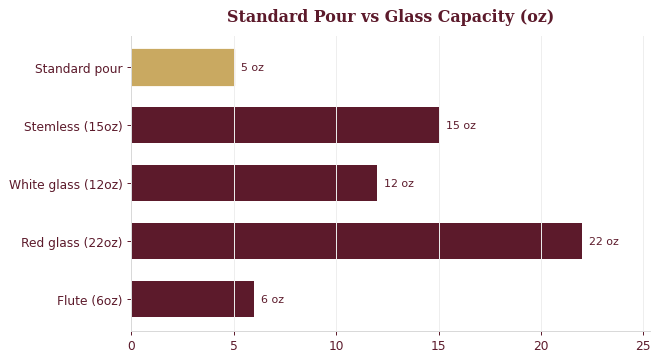
    A standard restaurant pour is about 5 ounces, which means a 12- to 22-ounce glass is never filled anywhere near the top. That headroom is intentional: it lets wine breathe and concentrates aroma. The chart below contrasts glass capacities with the standard pour so you can see how much room each design leaves.

    Glass capacity far exceeds the standard 5-ounce pour — the headroom is by design.
    Glass capacity far exceeds the standard 5-ounce pour — the headroom is by design.

    Bigger bowls aren’t about bigger pours; they’re about surface area for aeration. A 22-ounce red glass still holds a 5-ounce pour — it just gives the wine room to open up.

    How full to pour by glass type

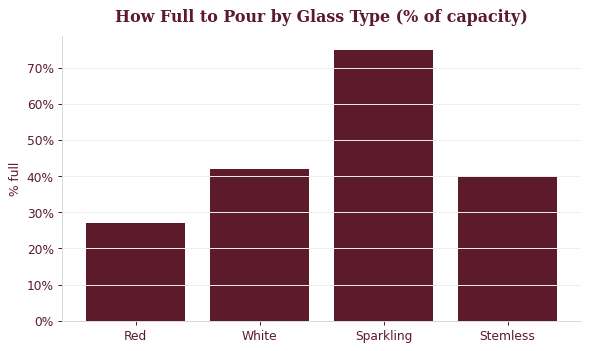
    Fill level varies by style. Reds are poured to roughly a quarter of the bowl, whites to about 40%, and sparkling nearly to the top to preserve bubbles. Getting fill right keeps service consistent and controls cost across a busy night.

    Recommended fill level as a share of capacity varies sharply by wine type.
    Recommended fill level as a share of capacity varies sharply by wine type.
    Train staff to a visual fill line for each glass in your service. Consistent pours protect both the guest experience and your cost per bottle — the number-one lever in beverage margin.

    Why capacity affects branding placement

    Capacity and bowl shape determine where a logo or etch sits cleanly. On a large red bowl, branding placed too high disappears above the pour line; on a flute, the narrow body limits imprint width. Match your artwork to the glass so it stays visible when the glass is in use.

    Speccing glassware for your venue

    Choose capacity by your dominant service: a wine-by-the-glass program favors versatile 12–15 ounce all-purpose glasses, while a fine-dining red program justifies larger bowls. For events, all-purpose stemless in a durable capacity simplifies inventory and reduces breakage.

    Glass Capacity Typical pour
    Flute 6 oz 4–5 oz sparkling
    White 12 oz 5 oz
    All-purpose 15 oz 5–6 oz
    Red 22 oz 5–6 oz

    Ordering favors or gifts instead? See our companion guide, our Custom Wine Glasses as Wedding Favors: Ideas, Etching & Budget. Browse our custom wine glasses, read more guides, or contact us.

    How bowl shape works with capacity to shape the wine

    Capacity tells only part of the story; the shape of the bowl determines how that volume interacts with the wine. A wide, generous bowl increases the surface area in contact with air, accelerating aeration and lifting aromatics — which is why big reds are served in large bowls even though the pour is modest. A narrower bowl preserves delicate aromatics and keeps sparkling wine’s bubbles intact, which is why flutes and tighter whites glasses run smaller. Matching bowl shape to the wine you pour most is as important as choosing the right capacity.

    For venues that pour a single all-purpose glass, a medium bowl around fifteen ounces is a sensible compromise: enough room for reds to open, but not so large that whites feel lost. Fine-dining programs that want to showcase specific varietals justify a small range of shapes, while high-volume and event settings usually standardize on one versatile bowl for durability and simple inventory.

    Durability, stem choice, and service realities

    The right glass on paper still has to survive a busy service. Stemmed glasses look elegant but are more vulnerable at the stem and in dish pits, so restaurants weigh replacement cost against presentation. Stemless glasses trade a little formality for durability and easier storage, making them a practical choice for events, patios, and by-the-glass programs. Break-resistant or tempered options extend life in the highest-volume settings.

    Capacity interacts with these realities. Larger bowls are more exposed to knocks and take more rack space, so a venue running big red glasses should plan for higher breakage and storage needs, while a compact all-purpose glass stretches an inventory budget further. Deciding how many glasses to stock per seat, plus a breakage buffer, keeps service smooth without over-investing in fragile stemware.

    Training staff to pour consistently

    Consistent pours are the single biggest lever in beverage cost control, and they depend on training, not guesswork. Give staff a visual reference for each glass — a fill line at the widest point of a red bowl, a set level for whites, a near-full pour for sparkling — and reinforce it with a jigger or measured pour spout where appropriate. A five-ounce pour that drifts to seven quietly erodes margin across a busy night.

    Periodic pour checks and a simple house standard keep the whole team aligned, and they protect the guest experience too: every table gets the same generous, correct serve. Pairing the right glass capacity with a trained, consistent pour is what turns glassware from a cost center into a quiet driver of both quality and profit. Over a month of service, even a half-ounce of pour discipline per glass adds up to real bottles saved, which is why the best programs treat the pour standard as seriously as the wine list itself.

    Common questions about wine glass capacity

    Why are wine glasses so much bigger than the pour?

    The extra capacity is headroom by design. A five-ounce pour in a twelve-to-twenty-two-ounce bowl gives the wine room to breathe and concentrates aroma; the big bowl is about surface area for aeration, not a bigger serving.

    What single capacity works best for a mixed program?

    A medium all-purpose glass around fifteen ounces is the most versatile choice, roomy enough for reds to open without swallowing whites. It simplifies inventory for by-the-glass programs and events while still serving most varietals well.

    How full should each type of wine be poured?

    As a guide, pour reds to about a quarter of the bowl, whites to roughly forty percent, and sparkling nearly to the top to preserve bubbles. Train staff to a visual fill line per glass so pours stay consistent.

    Does capacity affect where my logo should go?

    Yes. On a large bowl, branding placed too high sits above the pour line and disappears in use, while a flute’s narrow body limits imprint width. Match artwork placement to the glass so the logo stays visible when the glass is filled and in hand.

    How many glasses should a venue stock per seat?

    A common starting point is two to three glasses per seat for the styles you pour most, plus a breakage buffer sized to how busy and how formal your service is. Larger, more fragile bowls warrant a bigger buffer and more rack space, while durable all-purpose or stemless glasses stretch the same budget further and are easier to store and replace.

    Speccing branded glassware for your venue?

    We’ll match capacity, shape, and logo placement to your service and your pours.

    Get a Quote

  • Custom Wine Glasses as Wedding Favors: Ideas, Etching & Budget

    Custom Wine Glasses as Wedding Favors: Ideas, Etching & Budget

    Custom Wine Glasses as Wedding Favors: Ideas, Etching, and Budget

    Wedding wine glass favors are that rare guest gift that actually gets used — long after the cake is gone, a personalized glass lives in the cupboard and comes out at dinner. That reuse is exactly why custom wine glasses have become a favorite favor: they double as the reception’s drinkware and the keepsake guests take home. This guide covers styles, etching options, and how to budget wedding wine glass favors for your headcount.

    Done well, favor glasses do triple duty — place card, drinkware, and thank-you gift — which is why couples find them easier to justify than a trinket destined for a drawer.

    Styles that work as favors

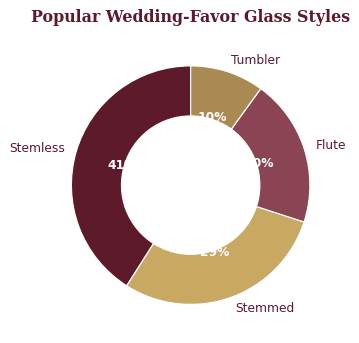
    Stemless leads for favors: it’s durable, stacks for transport, and suits both wine and cocktails. Stemmed glasses feel more formal, flutes suit a sparkling toast, and tumblers read casual and modern. Your venue and menu point to the right pick.

    Stemless glasses are the most popular wedding-favor style, followed by stemmed and flutes.
    Stemless glasses are the most popular wedding-favor style, followed by stemmed and flutes.

    For outdoor and standing receptions, stemless wins on stability and breakage; for a seated formal dinner, stemmed glasses elevate the table. Many couples mix — stemless for the crowd, a few stemmed for the head table.

    Etching and personalization options

    Etched (or sand-carved) glasses give a frosted, permanent, dishwasher-safe mark that feels the most premium — ideal for a monogram, wedding date, or names. Printed designs allow full color for themed weddings, while engraving suits crisp logos and initials. Etching is the classic favor look because it never fades and survives real use.

    Pairing names with the date on the back and a small monogram on the front lets one glass serve as both a place card and a keepsake — no extra stationery needed.

    Design tips that photograph well

    Keep favor artwork simple and centered so it reads in photos and across a table. A single monogram or a two-line name-and-date usually beats a busy crest. Confirm the etch area for your chosen glass shape before you finalize.

    Budgeting favors for your headcount

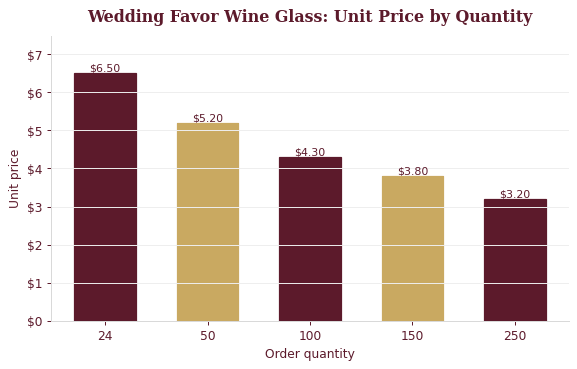
    Per-glass cost drops as quantity rises, so favors scale kindly with a larger guest list. The curve below shows typical pricing; add roughly 5–10% extra to cover breakage and last-minute additions.

    Per-glass favor pricing falls as quantity increases — larger weddings enjoy a lower unit cost.
    Per-glass favor pricing falls as quantity increases — larger weddings enjoy a lower unit cost.
    Guest count Style tip Order extra
    Up to 50 Stemmed or stemless +10%
    50–120 Stemless for durability +8%
    120+ Stemless, simple etch +5%

    For shape and pour details, see our companion guide, our Wine Glass Capacity & Pour Sizes: A Guide for Venues & Events. Explore our custom wine glasses and contact us to price your favors.

    Timing your favor order around the wedding calendar

    Personalized glassware is a made-to-order item, so timing matters as much as design. Plan to finalize your artwork and headcount roughly six to eight weeks before the wedding, which leaves room for a proof, production, and shipping without a rush fee. If your date falls in peak wedding season, add a buffer, since decorators and glass suppliers run busiest from late spring through early fall. Locking the order early also protects your chosen glass style from going out of stock.

    Work backward from the event: confirm your final guest count, approve a digital or physical proof, place the order, and aim to have the glasses in hand at least a week before the wedding so you can pack favors calmly rather than the night before. Building in that margin turns wedding wine glass favors from a last-minute stressor into a finished detail you can check off early, and it leaves a cushion if a proof needs a small revision or a shipment is delayed in transit.

    Displaying and packaging favors at the reception

    How you present favor glasses shapes how special they feel. A favor table with the glasses arranged by name doubles as an escort display, guiding guests to their seats while showing off the personalization. Simple touches — a sprig of greenery in each glass, a tag tied to the stem, or a tissue-lined box for take-home — elevate the moment without much cost. If glasses double as the reception’s drinkware, a small ‘take me home’ sign encourages guests to keep theirs.

    Packaging protects the investment on the way home. For stemmed glasses, a compartment box or individual sleeves prevent chips; for stemless and tumblers, a simple kraft box or drawstring bag works and looks intentional. Provide a small stack of extra boxes at the exit for guests who arrived without bags, and your favors will actually make it home intact rather than being left on tables.

    Coordinating favors with the rest of your tabletop

    Favor glasses look most polished when they echo the wider design of the day. Match the etch or print color to your invitation suite or menu cards, and let the glass style reflect the formality of the reception — stemmed for a seated dinner, stemless or tumblers for a relaxed or outdoor celebration. Repeating your monogram or wedding date across favors, signage, and stationery ties the tabletop together into one cohesive look.

    If your budget allows a small splurge, a slightly elevated glass for the head table or a different accent color for the wedding party adds a subtle hierarchy without breaking the theme. Keep the core guest favor simple and consistent so the personalization reads clearly in photos and across a long table.

    Common questions about wedding wine glass favors

    How far in advance should I order favor glasses?

    Aim to finalize art and headcount six to eight weeks out, with extra buffer in peak season. That leaves time for a proof, production, and shipping, and gets the glasses to you about a week before the wedding so you can pack favors without a rush.

    Etched or printed — which lasts longer on a keepsake?

    Etched or sand-carved marks are frosted, permanent, and dishwasher-safe, which is why they are the classic favor choice for a lasting keepsake. Printing allows full color for themed designs but is generally less durable than etching over years of washing.

    How many extra glasses should I order?

    Order roughly five to ten percent over your guest count to cover breakage and last-minute additions, leaning toward ten percent for larger weddings and shipped orders. Extras also make handy replacements if a few are left behind.

    Can favor glasses double as the reception drinkware?

    Yes, and it is a popular way to justify the cost — the glass serves as place card, drinkware, and take-home gift. Add a small sign inviting guests to keep their glass, and provide take-home boxes at the exit so they travel safely.

    What is the most popular style for wedding favor glasses?

    Stemless leads for favors because it is durable, stacks easily for transport, and works for both wine and cocktails, which makes it the safe choice for larger and outdoor weddings. Stemmed glasses suit formal seated dinners, and flutes fit a sparkling toast, so many couples mix styles to match different parts of the day while keeping one etch design across all of them.

    Planning wedding favors guests will keep?

    Send your names, date, and headcount and we’ll quote personalized glasses to match your day.

    Get a Quote

  • Restaurant Wine Glasses: Durability & Replacement Math

    Restaurant Wine Glasses: Durability & Replacement Math

    Restaurant Wine Glasses: Durability & Replacement Math

    Ask any operator what their stemware costs and they will quote you the per-glass price from the last invoice. Ask what their stemware costs per year and the room goes quiet. The real economics of restaurant wine glasses live in the replacement rate, not the purchase price — a $4 glass replaced five times costs more than a $12 glass replaced once, before you count the reorder freight, the mismatched-rack look during the gap, and the staff time spent managing it. This guide works through the breakage math, what actually makes commercial glassware durable, and how to choose a program that survives your dish pit.

    Where Glasses Actually Die

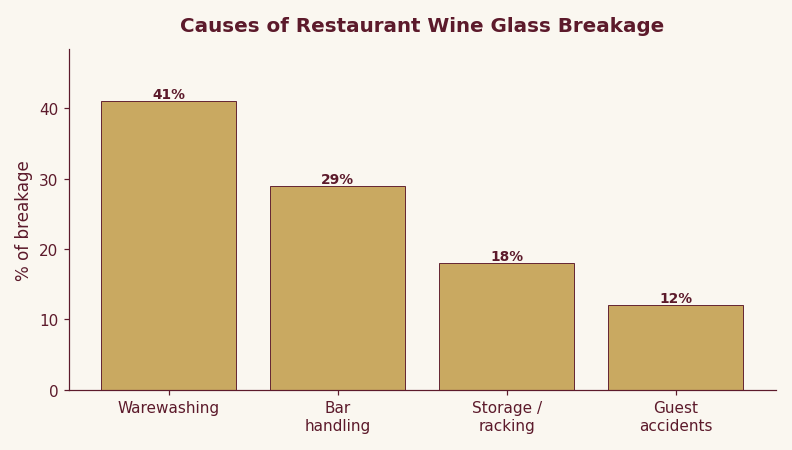
    Operators assume guests break glassware. Mostly, the building does. Industry loss patterns are remarkably consistent: the majority of stemware losses happen behind the bar and in the warewashing area, not on the floor.

    Bar chart showing causes of restaurant wine glass breakage, with warewashing and bar handling far ahead of guest accidents
    Typical breakage causes in full-service restaurants. The dish pit — not the dining room — is where stemware programs go to die.

    That distribution matters because it tells you what to buy for. Guests barely factor; racking, thermal shock, and rim-first handling dominate. A glass optimized to survive the dishwasher — reinforced rim, tempered bowl, a stem that tolerates racking — will outlast a prettier glass every time, and the design differences are mostly invisible to the guest.

    What “Durable” Actually Means in Commercial Glassware

    Tempering and Rim Reinforcement

    Fully tempered glass carries surface compression that resists chipping — most breakage begins as a rim chip that becomes a crack two washes later. Reinforced or rolled rims raise chip resistance dramatically, and laser-cut rims, while more elegant, demand gentler handling. For high-volume service, a reinforced-rim tempered glass is the workhorse spec.

    Stem Construction

    Pulled stems (drawn from the same glass as the bowl) are stronger than joined stems (welded on). Titanium-alloyed stems, now common in mid-market commercial lines, bend fractionally instead of snapping. If your service style involves carrying glasses by the stem in bouquets, this is where the money goes.

    The One-Rack Rule

    Durability is also operational. Glasses that fit your standard warewasher racks — with headroom — break less, full stop. Many “fragile glass” problems are actually “wrong rack” problems, and a $200 rack order fixes what looks like a $2,000 glassware problem.

    The Replacement Math, Worked

    Here is the calculation every beverage program should run once a year, shown for a 120-seat full-service restaurant stocking 300 wine glasses.

    Program Cost per glass Annual breakage rate Glasses replaced/yr Annual replacement cost
    Budget catering-grade $3.75 85% 255 $956
    Mid-tier tempered, reinforced rim $7.50 40% 120 $900
    Premium commercial, pulled stem $11.50 22% 66 $759

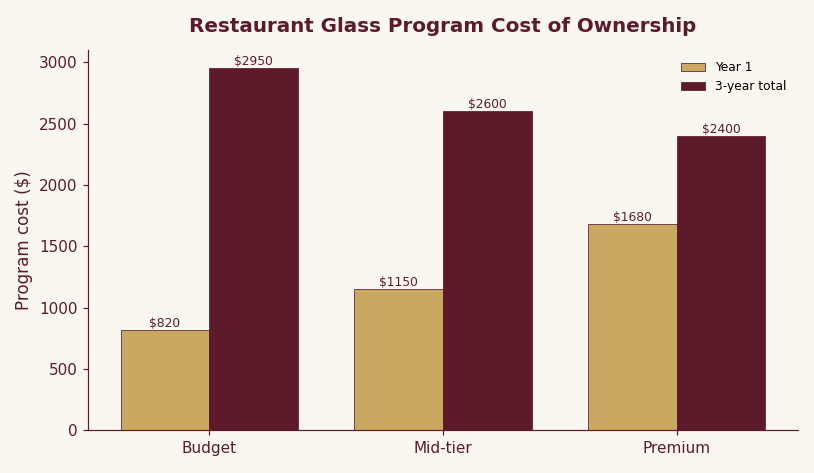
    Read that last column again: the premium glass is the cheapest program to run, and the gap widens once you add freight on frequent reorders and the soft costs of rack gaps and mismatched replacements. Purchase price is a one-time number; breakage rate compounds every month you operate.

    Grouped bar chart comparing first-year and three-year total cost of restaurant wine glass programs across budget, mid-tier, and premium glassware
    Three-year total cost of ownership for the same 300-glass program. The premium spec overtakes budget glass before the end of year one.
    Operator’s tip: Track breakage weekly by cause, not just count — a tally sheet at the dish pit with three columns (washing, bar, floor) takes staff seconds and tells you in a month whether your problem is the glass, the racks, or the training. Most operators discover one fixable habit is costing them a case of stemware a month.

    One Shape or Three? The Program Question

    Varietal-specific stemware is a pleasure in fine dining, but every additional shape multiplies your par stock, rack types, and reorder complexity. For most full-service concepts, the durable answer is one excellent universal glass for the core list plus a single larger bowl for premium reds. Catering operations and event venues should go further and standardize on one shape entirely — when 400 glasses come back on carts at midnight, uniformity is durability.

    Branding Without Breakage

    Etched logos and custom marks do not weaken a properly tempered glass — etching removes microns from the surface, well inside the compression layer. What matters is placement: keep etching off the rim area and upper bowl flex zone, and specify it low on the bowl or on the foot. A subtly etched house mark also has a practical benefit no one advertises: branded glassware walks out the door far less often than plain stemware, and shrinkage is a real line in the breakage budget.

    Choosing a Partner, Not Just a Glass

    The right restaurant wine glasses are a spec, a rack plan, and a reorder relationship. Look for a supplier who will quote replacement pricing and hold your pattern in stock — continuity is worth more than a discount on round one, because the mismatched-glassware look costs you on every table turn. We keep house patterns on file precisely for this reason; read about our process on the about page, see more operator guides on the blog, or get in touch to talk through your program. If your venue also hosts weddings, our guide to wedding toasting glasses covers the keepsake side of event glassware.

    Run the math on your own numbers before the next reorder. In stemware, as in most operating decisions, the cheap option and the low-cost option are rarely the same glass — and the difference shows up every single year you keep the doors open.

    Stemware that survives the dish pit — and the math.

    Commercial-grade wine glasses, custom etching, and replacement pricing held on file for your pattern.

    Get a Quote

  • Wedding Toasting Glasses: Flutes, Coupes & Personalization

    Wedding Toasting Glasses: Flutes, Coupes & Personalization

    Wedding Toasting Glasses: Flutes, Coupes & Personalization

    Of all the glassware at a wedding, only two pieces make it into the photo album, the highlight reel, and — decades later — the anniversary table. Choosing wedding toasting glasses is one of those small decisions that quietly outlasts most of the big ones: the couple will hold these glasses during the most photographed ninety seconds of the reception, and many will drink from them every anniversary after. This guide covers where the toasting tradition comes from, how to choose between flutes and coupes, what personalization options exist, and when to order so the glasses arrive engraved, proofed, and ready for the big day.

    A Short History of the Wedding Toast

    The toast predates the glassware. Raising a cup to health and fortune runs back through medieval banquet culture, and the dedicated wedding toasting glass emerged as couples began keeping a marked pair from the celebration — a tradition that grew teeth in the nineteenth century when etched and engraved glass became affordable enough for middle-class weddings. The modern version of the ritual is remarkably stable: the couple’s glasses are distinct from every other glass in the room, they are used for the first toast, and they go home with the couple as the first heirloom of the marriage. That last part is why the choice deserves more thought than the rental stemware does.

    Flute, Coupe, or Trumpet: Choosing the Shape

    Three silhouettes dominate the toasting-glass market, and each carries a different personality on camera and in hand.

    The Flute

    Tall, narrow, and engineered for sparkle: the flute’s small surface area preserves carbonation, so the champagne is still lively when the speeches run long. Its height also makes it the most photogenic shape in a clinking shot. If the couple wants the classic look — and most do — the flute is the default for a reason.

    The Coupe

    The coupe is the vintage romantic of the family — broad, shallow, Gatsby-coded. It loses bubbles quickly, which purists count against it, but for couples running a retro or garden-party aesthetic the silhouette is unbeatable. Coupes also engrave beautifully: the wide bowl gives the monogram room to breathe.

    The Trumpet

    Trumpet flutes flare from a narrow stem into a wider rim, splitting the difference — modern, sculptural, and popular in black-tie receptions. They tend to run taller and heavier, which reads as luxurious in hand but demands more care in transport.

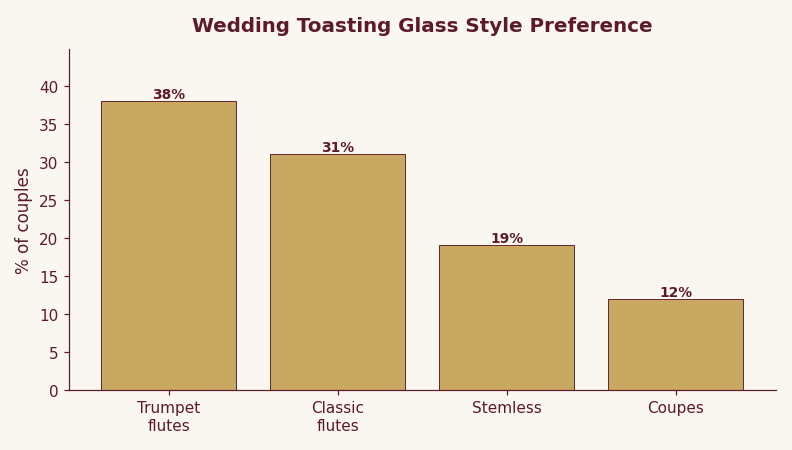
    Bar chart showing the share of couples choosing flutes, coupes, trumpet flutes, and stemless glasses as wedding toasting glasses
    Shape choices across the wedding orders we engraved last year. The classic flute still leads, but the coupe’s revival is real.
    Shape Best for Bubble retention Engraving canvas
    Flute Classic receptions, long speeches Excellent Narrow — best for dates & names
    Coupe Vintage & garden themes Fair Wide — ideal for monograms
    Trumpet Black-tie, modern venues Good Generous mid-bowl surface
    Stemless Outdoor & casual weddings Good Large wraparound area

    Personalization: Making the Pair Unmistakably Theirs

    Personalization is what separates toasting glasses from the caterer’s stemware, and the options range from restrained to fully bespoke.

    Names & Wedding Date

    The timeless choice: first names and the date, etched in a script or serif face. On flutes, this runs vertically or in a small arc; on coupes, it sits centered on the bowl. It photographs cleanly and never dates itself.

    Monograms & Crests

    A shared-surname monogram — or a newly designed family crest — gives the pair an heirloom quality from day one. Interlocking-letter designs suit coupes and trumpets; single-letter marks suit flutes.

    Roles & Phrases

    “Mr.” and “Mrs.”, “Better” and “Half”, a line from the vows, or the couple’s shared joke. Short phrases work best: etching rewards restraint, and three words at a readable size beat a paragraph nobody can make out.

    Deep Etch & Gilded Accents

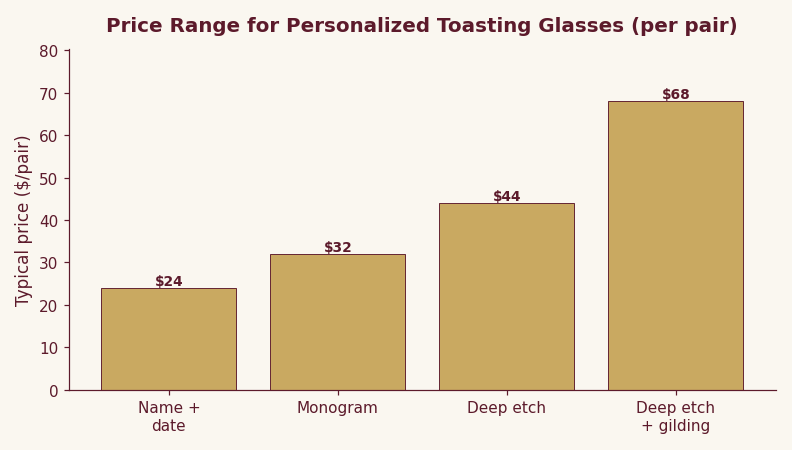
    Beyond surface etching, deep-carve engraving adds shadow and dimension, and gold or silver rim gilding turns the pair into true display pieces. These finishing touches typically add $15–$30 per pair and photograph spectacularly in candlelight.

    Bar chart of typical price ranges for personalized wedding toasting glasses by engraving option, from names and date to deep etch with gilding
    Typical per-pair pricing by personalization level. Even the fully bespoke tier costs less than the cake topper most couples forget by year two.
    Planning tip: Order your toasting glasses at least six weeks before the wedding — not because engraving takes that long, but because you want the proof approved and the pair delivered before the final month, when every vendor decision starts competing for the same attention. A delivered, checked-off keepsake is one less week-of worry.

    Practical Details Couples Ask About

    • Should the pair match the reception stemware? No — contrast is the point. The toasting pair should read as distinct in photos.
    • Etching or printing? Etching. It is permanent, dishwasher-resilient, and feels engraved because it is. Printed designs on keepsake glassware tend to wear within a few years of anniversary use.
    • What about the wedding party? Many couples extend the theme with engraved glasses for the bridal party — a natural companion order, and one we cover in our bridal party gift guide on the blog.
    • One pair or two? Consider a backup pair if the venue handles the glasses overnight. At typical price points, insurance is cheap.

    An Heirloom, Not an Accessory

    The best wedding toasting glasses are chosen the way the rings were: as objects that will still mean something at the twenty-fifth anniversary. Pick the shape that fits the couple, keep the engraving legible and personal, and order early enough to enjoy the proofing process rather than race it. Years from now, when the pair comes out of the cabinet each anniversary, the ninety seconds they were first raised will come back with them.

    You can read more about our etching process on the about page, browse the full custom glassware collection, or contact us with a design idea. And if you are also outfitting the venue side of an event, our companion guide to restaurant wine glasses and replacement math looks at durability from the professional angle.

    Two glasses. One toast. Every anniversary after.

    Engraved toasting flutes and coupes, proofed before etching and delivered weeks ahead of the date.

    Get a Quote

  • How Many Wine Glasses to Order: Event Quantity Guide

    How Many Wine Glasses to Order: Event Quantity Guide

    How Many Wine Glasses to Order: Event Quantity Guide

    One of the most common planning questions we hear is also the easiest to get wrong: how many wine glasses to order for an event. Order too few and you’re washing glasses mid-service; order without a breakage buffer and a dropped tray leaves you short. The right number depends on your guest count, service style, and venue — and a little math up front saves a lot of stress on the night.

    This guide gives you a practical way to calculate how many wine glasses to order, including the buffer that keeps you covered when a few inevitably break.

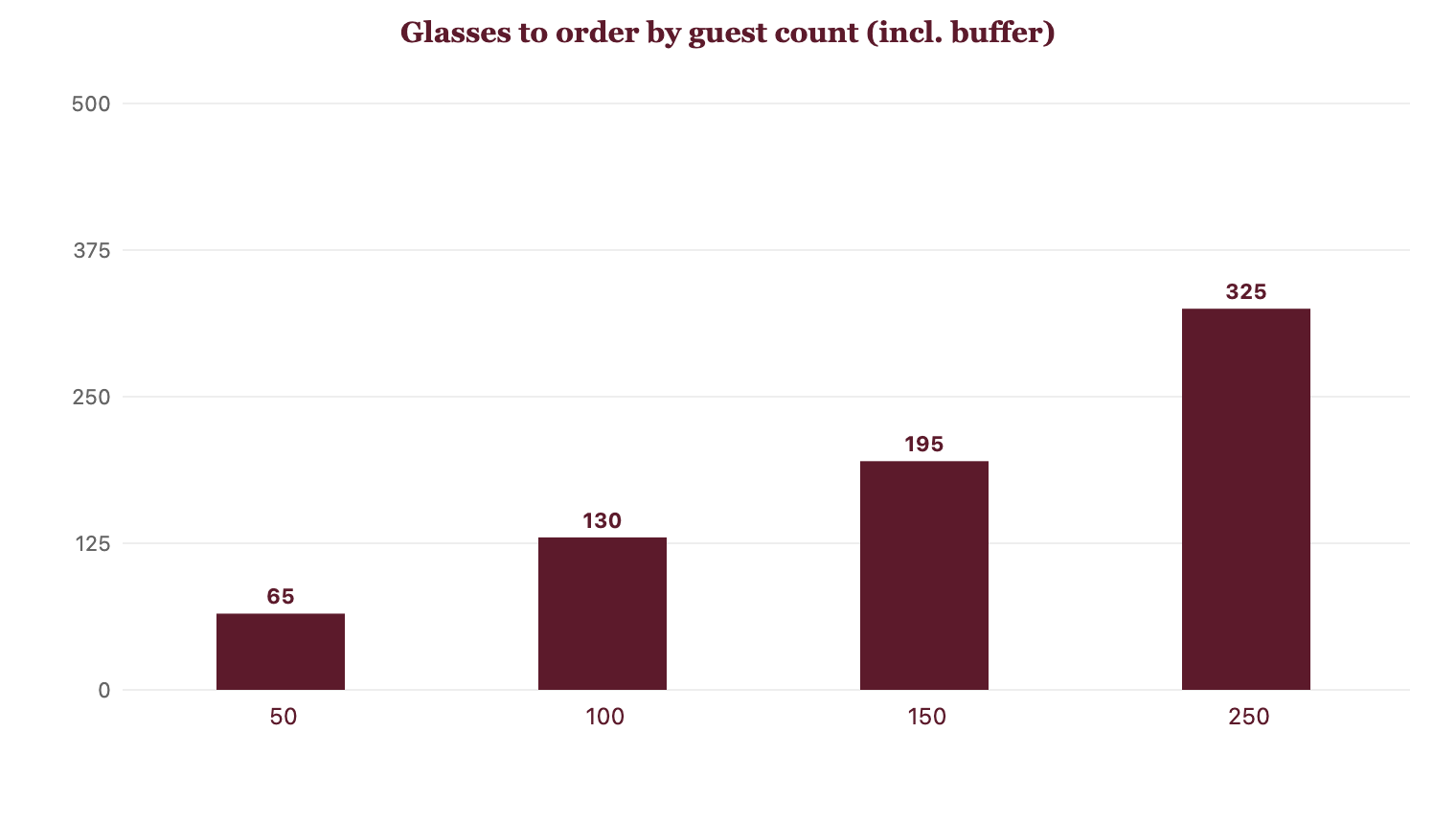
    Order roughly 1.3 glasses per guest to cover swaps and breakage.
    A simple rule: budget about 1.3 glasses per guest before venue adjustments.

    Start with guests, not glasses

    Begin with your confirmed headcount, then adjust up. Guests set glasses down and lose them, switch from red to white, and a share get broken. For most seated events, planning about 1.3 glasses per guest covers normal swaps and losses. Standing receptions run higher because guests set glasses down and grab fresh ones.

    Adjust for service style and venue

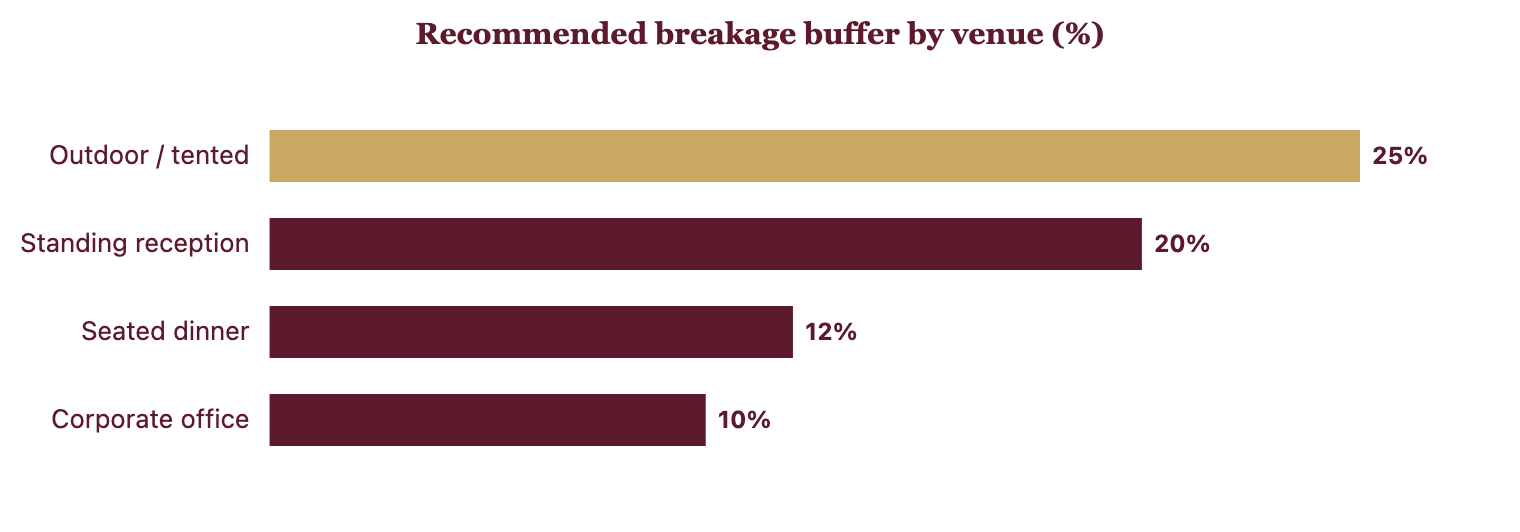
    Where and how you serve changes the buffer. Outdoor and tented events see more breakage from uneven ground and wind; seated dinners in a controlled room see the least.

    Outdoor and standing events need a larger breakage buffer than seated dinners.
    Set your breakage buffer by venue — outdoor and standing events need more.

    Buying vs. renting

    If glasses are custom and meant as keepsakes, you’re buying one per guest plus a modest overage — no return logistics, and guests take them home. If they’re for service only, order enough working stock plus the breakage buffer. For branded keepsake events, the take-home factor is the whole point, so plan one clean glass per guest and a small surplus for replacements.

    Branding a gala or launch? Quantity planning pairs with style and etch choices — see our companion guide on custom wine glasses for corporate events.

    A quick worked example

    For a 150-guest outdoor gala with custom keepsake glasses: 150 take-home glasses, plus a 25% outdoor buffer for breakage and replacements, lands you around 190. Round up to the nearest packing increment and you’re covered without a mountain of surplus.

    Bottom line

    Figuring out how many wine glasses to order comes down to headcount times a per-guest factor, plus a venue-based breakage buffer. Plan about 1.3 glasses per guest for service, one per guest plus overage for keepsakes, and widen the buffer for outdoor and standing events. Do the math once and the night runs smoothly.

    Get a quantity quote

    Tell us your guest count and venue and we’ll recommend a quantity, buffer, and custom design.

    Get a Quote

    About · Blog · Contact · Companion: glasses for corporate events

  • Custom Wine Glasses for Corporate Events & Galas

    Custom Wine Glasses for Corporate Events & Galas

    Custom Wine Glasses for Corporate Events & Galas

    A branded cocktail napkin gets tossed; a beautifully etched wine glass gets taken home. That’s the quiet power of custom wine glasses for events — they elevate the room during the evening and keep working as a keepsake long after. For galas, client dinners, and product launches, custom glassware turns a standard bar into a branded experience without a banner in sight.

    This guide covers where custom wine glasses for events make the biggest impression, how to match glass style to the tone of the evening, and how to brand tastefully enough for a black-tie crowd.

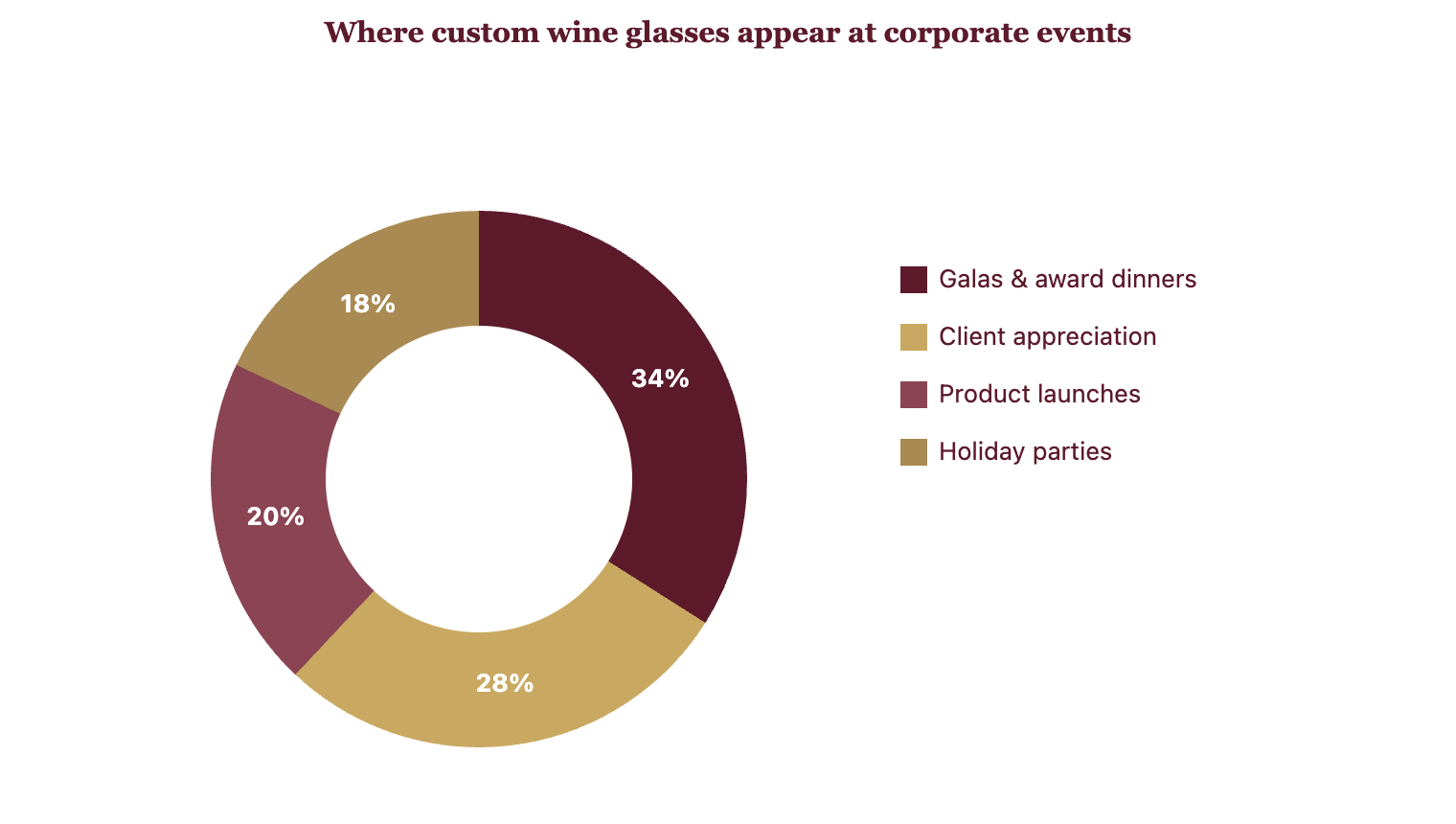
    Custom wine glasses appear across galas, client appreciation, and launch events.
    Custom glassware shows up wherever a brand wants the evening to feel considered.

    Why glassware beats the usual swag

    At a corporate event, most branded items compete for pocket space and lose. A wine glass is different: it’s in the guest’s hand all night, catches the light on every table, and carries a subtle etch rather than a loud logo. Guests keep quality stemware, which means your brand rides home with them and reappears at their next dinner party.

    Match the glass to the evening

    Stemmed for formal

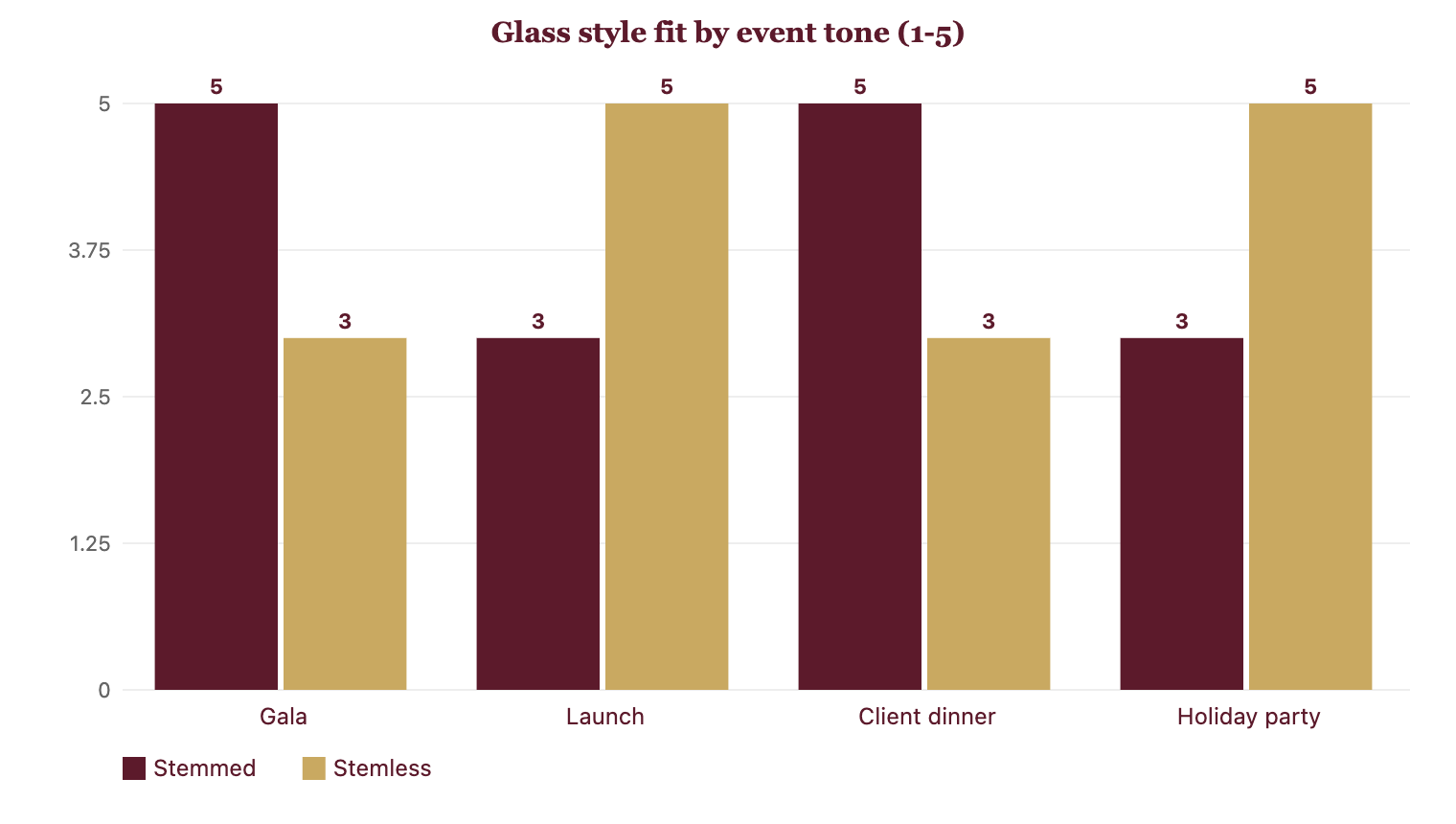
    Galas, award dinners, and seated client events call for stemmed glasses — they read as polished and keep the wine at temperature. For the varietal-shape logic, see our wine glass shapes guide.

    Stemless for relaxed

    Product launches, mixers, and holiday parties suit stemless: harder to tip, easier to hold with a plate, and more modern. Our stemmed vs stemless guide weighs the trade-offs.

    Stemmed glasses suit formal events; stemless fits relaxed receptions.
    Let the tone of the event choose the silhouette.

    Branding for a discerning crowd

    The rule at corporate and gala events is restraint. A small etched monogram, event date, or crest reads as premium; a full-color logo does not. Etching also survives dishwashers and years of use, so the glass keeps its finish. For decoration options, our etched vs printed guide compares the methods.

    Planning the bar count? Order the right quantity with a sensible breakage buffer — see our companion guide on how many wine glasses to order.

    A simple event playbook

    Pick one glass style for the evening, keep the etch small and elegant, and order early enough to approve a proof. For recurring events, a single reusable design keeps your brand consistent season to season and lowers per-event cost.

    Bottom line

    Custom wine glasses for events do what a banner can’t: they sit in every guest’s hand, dress the room, and go home as a keepsake. Match stemmed or stemless to the tone, brand with a discreet etch, and your gala or launch will feel considered from the first pour to the last.

    Design glassware for your event

    Tell us your event and guest count and we’ll recommend a glass style, etch, and quantity.

    Get a Quote

    About · Blog · Contact · Companion: how many to order

  • Custom Wine Glasses for Wineries & Tasting Rooms: A Branding Guide

    Custom Wine Glasses for Wineries & Tasting Rooms: A Branding Guide

    A tasting room sells an experience, and the glass is the first thing a guest holds. Custom wine glasses for wineries turn an everyday pour into a branded moment — and a glass guests want to take home. Custom wine glasses for wineries do double duty: they elevate the tasting on-site and become a souvenir that markets your label long after the visit. This guide covers choosing the right glass for each pour, etching options, and how pricing works at volume.

    Right Glass for Each Pour

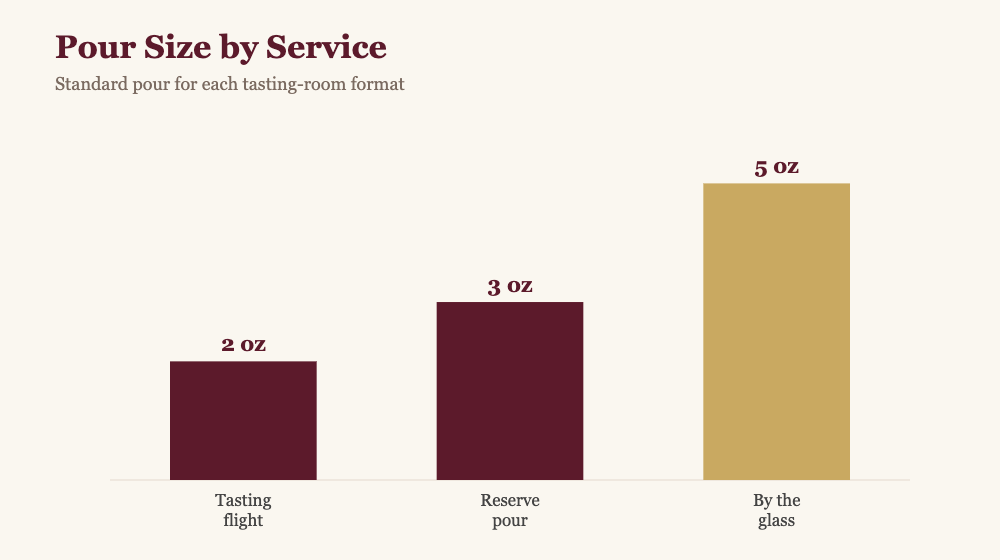
    Tasting rooms serve different formats, and the glass should suit the pour. A 2-ounce flight pour swims in an oversized goblet, while a generous by-the-glass serving needs room to breathe.

    Bar chart of pour size by service: tasting flight 2 oz, reserve pour 3 oz, by the glass 5 oz

    Many wineries standardize on a versatile mid-size stem that flatters flights and full pours alike, then add a stemless option for patios and events.

    Stemmed, Stemless, or Both

    Style Best for
    Stemmed The tasting bar, reserve flights, a refined look
    Stemless Patios, events, outdoor service, durability
    Logo tumbler Festivals and to-go souvenir sales

    Branding Options

    Deep etching gives a frosted, permanent logo that feels premium and survives the dishwasher — ideal for glasses that stay in service. Color printing reproduces a full-color label or crest for retail souvenir glasses. Most wineries use etching for the tasting bar and printing for the gift-shop shelf.

    Pricing at Volume

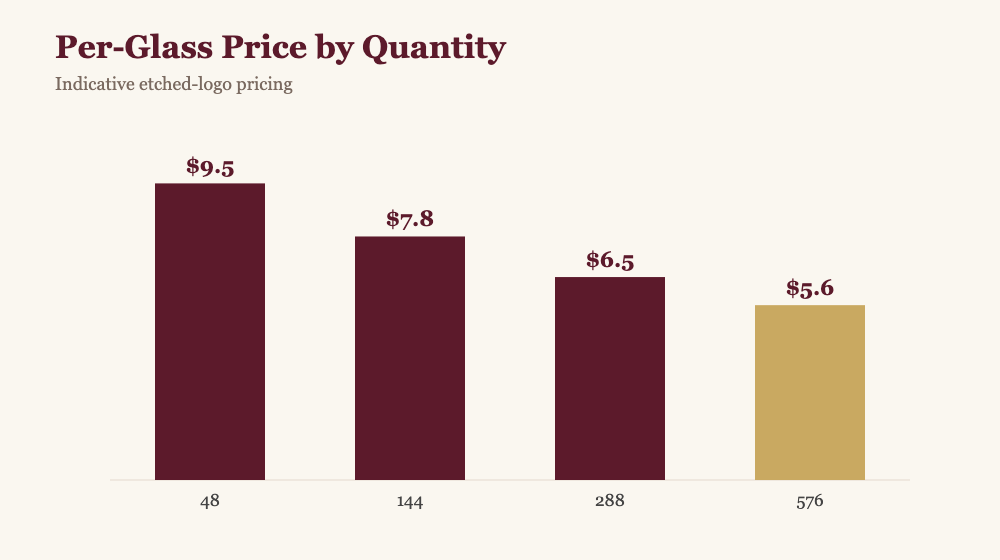
    Per-glass cost falls steadily as quantity rises, so ordering by the case for the season is far better value than small reorders.

    Bar chart of per-glass price by quantity: 48 glasses about $9.50 each down to 576 glasses about $5.60 each

    New to custom glassware? See how we work, browse the blog, or request a quote.

    Brand Every Pour

    Custom wine glasses for wineries are one of the highest-return branding pieces a tasting room can buy: they improve the on-site experience and keep selling your label at home. Pick a versatile stem, choose etching or print to match the use, and order by the case. Send us your logo and quantity for a quote with free mockups.

    Get a Quote

  • Etched vs Printed vs Engraved Wine Glasses: A Decoration Guide

    Etched vs Printed vs Engraved Wine Glasses: A Decoration Guide

    Etched vs Printed vs Engraved Wine Glasses: A Decoration Guide

    When you order custom etched wine glasses — or printed or engraved ones — the decoration method matters as much as the glass itself. It decides how premium the glass feels, how long your logo survives the dishwasher, and what the order costs. This guide compares sand-etching, printing, and laser engraving so you can match the finish to the occasion, whether you’re outfitting a restaurant, a wedding, or a branded retail line.

    The three ways to decorate a wine glass

    Sand etching abrades a frosted design into the glass — subtle, permanent, and elegant. Printing applies fired-on color for full-color logos and artwork. Laser engraving burns a precise mark into the surface, similar in feel to etching but sharper for fine detail.

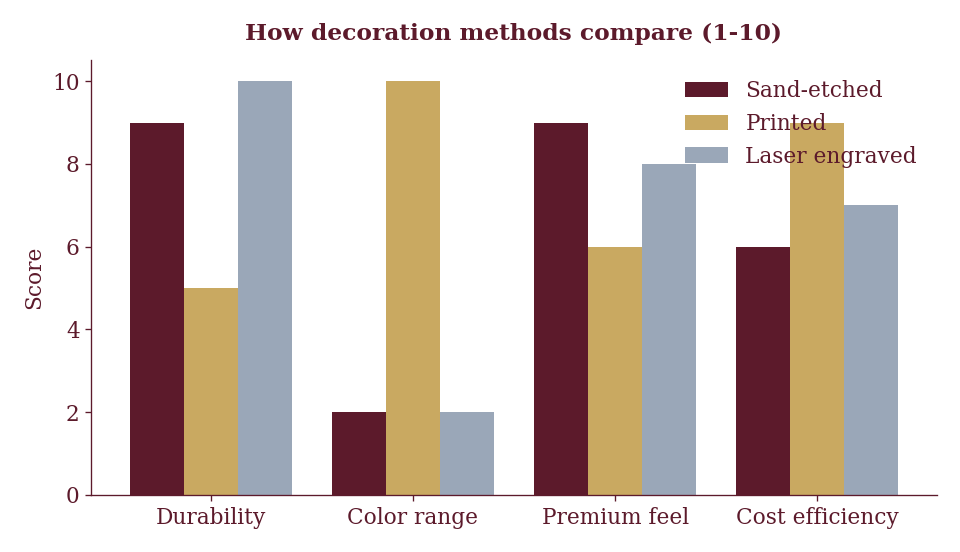
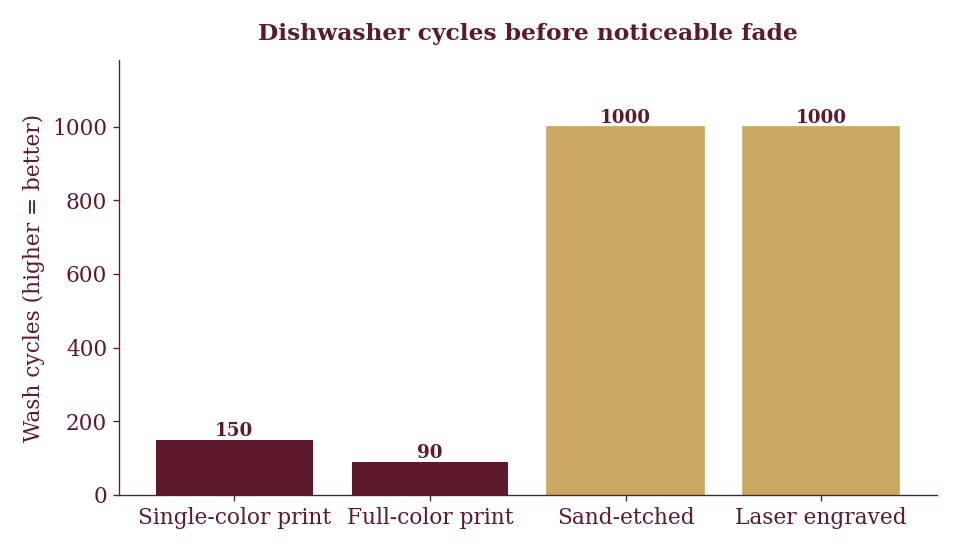
    Etching and engraving win on permanence and feel; printing wins on color and cost.
    Etching and engraving win on permanence and feel; printing wins on color and cost.

    Will it survive the dishwasher?

    For any venue glass, dishwasher durability is the deciding factor. Printed decoration can fade over time; etched and engraved marks are part of the glass and effectively permanent.

    Etched and engraved marks outlast printing through years of commercial washing.
    Etched and engraved marks outlast printing through years of commercial washing.
    For high-volume service, choose sand-etching or laser engraving. Save full-color printing for favors and gifts that won’t see a commercial dishwasher daily.

    Matching method to the occasion

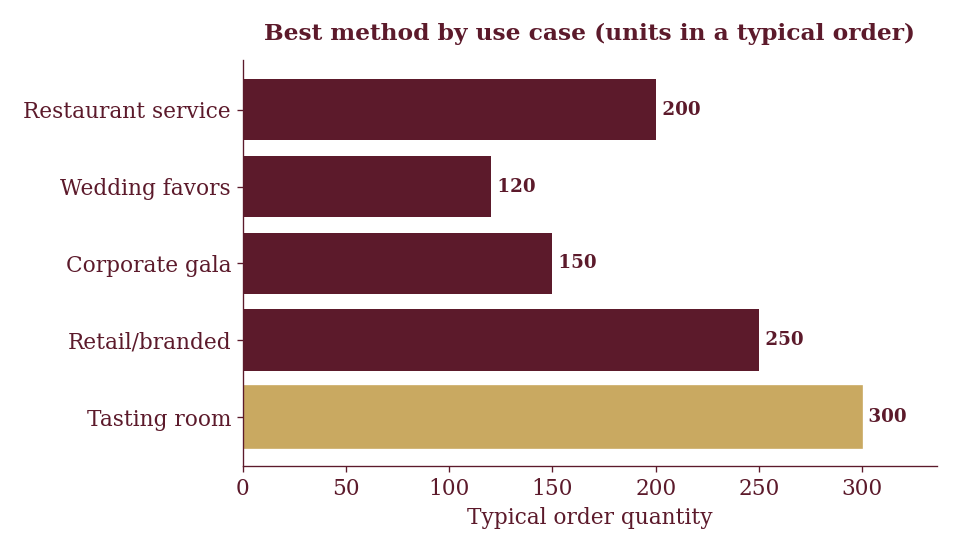
    Each method has a sweet spot. Here’s where each one tends to land, with typical order sizes so you can gauge setup costs.

    Restaurants and tasting rooms favor etching; favors and galas often use color printing.
    Restaurants and tasting rooms favor etching; favors and galas often use color printing.
    • Restaurant service: sand-etched — permanent, refined, dishwasher-proof.
    • Wedding favors: printed for themed color, or etched monograms for keepsakes.
    • Corporate gala: printed full-color logo for one-night impact.
    • Retail / branded line: etched or engraved for a premium shelf feel.
    • Tasting room: etched logo that survives constant washing.
    Still choosing the glass itself? See our companion guide to wine glass shapes by varietal before you decorate.

    Bottom line

    There’s no single best finish — only the right one for the job. Choose sand-etched or laser-engraved custom wine glasses when permanence and a premium feel matter, especially for daily service and retail. Reach for printing when you need full color for a one-time event or themed favor. Match the method to how the glass will live, and your branding will look as good on its hundredth wash as its first.

    Choose the right finish for your glasses

    Send your art and use case — we’ll recommend etched, printed, or engraved and quote it.

    Get a Quote

    About · More guides · Contact

  • Wine Glass Shapes by Varietal: Which to Customize for Your Venue

    Wine Glass Shapes by Varietal: Which to Customize for Your Venue

    Wine Glass Shapes by Varietal: Which to Customize for Your Venue

    Choosing wine glass shapes for a venue is part hospitality, part branding, and part practicality. The right bowl flatters the wine; the wrong one buries it. But you also can’t stock a dozen shapes behind a busy bar. This guide walks through the wine glass shapes that matter most by varietal, where stemmed beats stemless, and how to choose a custom glass that serves your list without overcomplicating your shelves.

    Why bowl shape changes the wine

    A glass does two jobs: it concentrates aroma and it directs the pour onto the right part of your palate. Big, wide bowls give bold reds room to open up; narrower bowls preserve the delicate aromatics of whites and sparkling. That’s why a Bordeaux glass dwarfs a flute.

    Bowl capacity climbs from sparkling flutes up to large-bowled Bordeaux glasses.
    Bowl capacity climbs from sparkling flutes up to large-bowled Bordeaux glasses.

    You don’t need every shape, though. Most venues do beautifully with three or four: a universal red, a white, a flute, and an all-purpose glass for high-volume service.

    Stemmed or stemless? Let the venue decide

    Stemware isn’t just aesthetic. Stems keep a hand’s warmth off the bowl and read as formal; stemless glasses are sturdier, stack better, and survive outdoor and high-volume settings.

    Stemmed suits fine dining and weddings; stemless wins outdoors and at busy bars.
    Stemmed suits fine dining and weddings; stemless wins outdoors and at busy bars.
    Hosting outdoors? Stemless or shatter-resistant glasses cut breakage dramatically at outdoor weddings and events without looking cheap when they’re custom etched.

    What to stock — and customize — for your list

    Match your glass mix to what you actually pour. A steakhouse leans red; a rooftop bar leans sparkling and white. Here’s a practical starting ratio per hundred covers.

    Stock to your pour mix — an all-purpose glass absorbs overflow on busy nights.
    Stock to your pour mix — an all-purpose glass absorbs overflow on busy nights.

    Whichever shapes you choose, a single custom etch or logo across the set ties the service together and turns glassware into quiet branding every time a guest lifts a glass.

    Three rules for choosing venue glassware

    1. Fewer shapes, better quality

    Three well-chosen shapes beat seven mediocre ones for both service and storage.

    2. Weight and rim matter

    A fine, cut rim feels premium; a thick rim feels like a banquet hall. Customers notice even if they can’t name why.

    3. Plan for breakage

    Order 15–20% over your floor count so a custom reorder isn’t an emergency mid-season.

    Decided on shapes? Next choose how to brand them. Our guide compares etched, printed, and engraved wine glasses on durability and feel.

    Bottom line

    The best venue glassware program isn’t the one with the most wine glass shapes — it’s the one matched to your pour list and finished with a consistent custom mark. Pick three or four shapes, choose stemmed or stemless by setting, order a healthy breakage buffer, and your glasses will flatter the wine and your brand in the same lift.

    Customize glassware for your venue

    Tell us your shapes and quantities and we’ll quote a custom-etched set.

    Get a Quote

    About · More guides · Contact

  • Wine Glass Types: Matching the Glass to the Wine

    Wine Glass Types: Matching the Glass to the Wine

    Wine Glass Types: Matching the Glass to the Wine

    Understanding wine glass types is the difference between simply drinking wine and actually tasting it. The bowl shape, the rim, and the stem all steer aroma and flow to the right part of your palate, which is why sommeliers obsess over wine glass types. The good news: you do not need a cabinet of twenty shapes. This guide explains the wine glass types that matter and which ones earn a place in your collection or your venue.

    Once you know how a few core wine glass types work, choosing glassware for a home, a wedding, or a restaurant gets much simpler.

    The core shapes

    GlassShapeBest for
    Bordeaux (red)Tall, broad bowlFull-bodied reds
    Burgundy (red)Wide, balloon bowlDelicate reds like Pinot Noir
    White wineNarrower, U-shapedCrisp whites
    Sparkling fluteTall, narrowChampagne, prosecco
    StemlessCasual, bowl onlyEveryday, outdoor events

    Why shape matters

    BowlWider bowls let reds breathe and open up
    RimDirects wine to the right part of the palate
    StemKeeps a hand from warming the wine
    Simple rule: bigger, rounder bowls for reds; narrower bowls for whites; flutes for bubbles. A good universal glass covers most needs if you only buy one.

    Choosing for your setting

    For a home, a single quality universal glass plus a flute handles almost everything. For a wedding or event, choose one elegant shape across the board for a cohesive look. For a restaurant, match the glass to your wine list and your dishwashing reality — durability matters as much as shape.

    Custom and branded glassware

    Any of these wine glass types can be engraved with a monogram, a couple’s initials, or a venue’s logo, turning standard stemware into a signature piece without changing how the glass performs.

    Learn a few core wine glass types, match the bowl to the wine, and pick one elegant shape for events — and you will pour every wine in the glass that flatters it most.

    Choosing glassware for your event or venue?
    Get a Quote

    More: visit our about page, browse the blog, or read about engraved wine glasses.