Restaurant Wine Glasses: Durability & Replacement Math
Ask any operator what their stemware costs and they will quote you the per-glass price from the last invoice. Ask what their stemware costs per year and the room goes quiet. The real economics of restaurant wine glasses live in the replacement rate, not the purchase price — a $4 glass replaced five times costs more than a $12 glass replaced once, before you count the reorder freight, the mismatched-rack look during the gap, and the staff time spent managing it. This guide works through the breakage math, what actually makes commercial glassware durable, and how to choose a program that survives your dish pit.
Where Glasses Actually Die
Operators assume guests break glassware. Mostly, the building does. Industry loss patterns are remarkably consistent: the majority of stemware losses happen behind the bar and in the warewashing area, not on the floor.
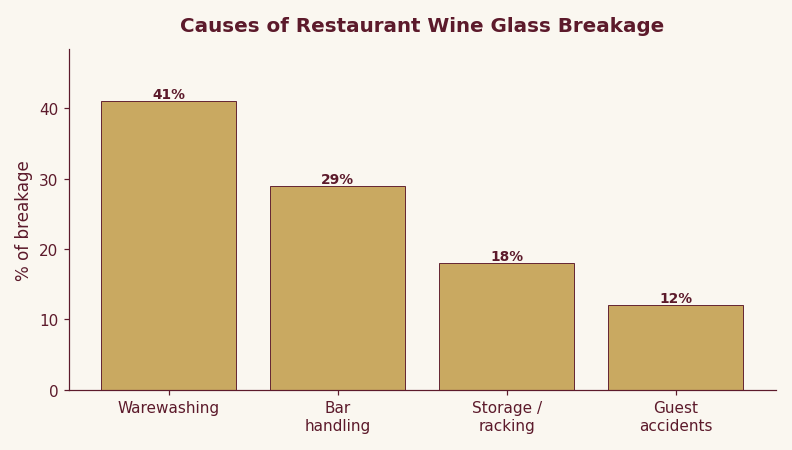
That distribution matters because it tells you what to buy for. Guests barely factor; racking, thermal shock, and rim-first handling dominate. A glass optimized to survive the dishwasher — reinforced rim, tempered bowl, a stem that tolerates racking — will outlast a prettier glass every time, and the design differences are mostly invisible to the guest.
What “Durable” Actually Means in Commercial Glassware
Tempering and Rim Reinforcement
Fully tempered glass carries surface compression that resists chipping — most breakage begins as a rim chip that becomes a crack two washes later. Reinforced or rolled rims raise chip resistance dramatically, and laser-cut rims, while more elegant, demand gentler handling. For high-volume service, a reinforced-rim tempered glass is the workhorse spec.
Stem Construction
Pulled stems (drawn from the same glass as the bowl) are stronger than joined stems (welded on). Titanium-alloyed stems, now common in mid-market commercial lines, bend fractionally instead of snapping. If your service style involves carrying glasses by the stem in bouquets, this is where the money goes.
The One-Rack Rule
Durability is also operational. Glasses that fit your standard warewasher racks — with headroom — break less, full stop. Many “fragile glass” problems are actually “wrong rack” problems, and a $200 rack order fixes what looks like a $2,000 glassware problem.
The Replacement Math, Worked
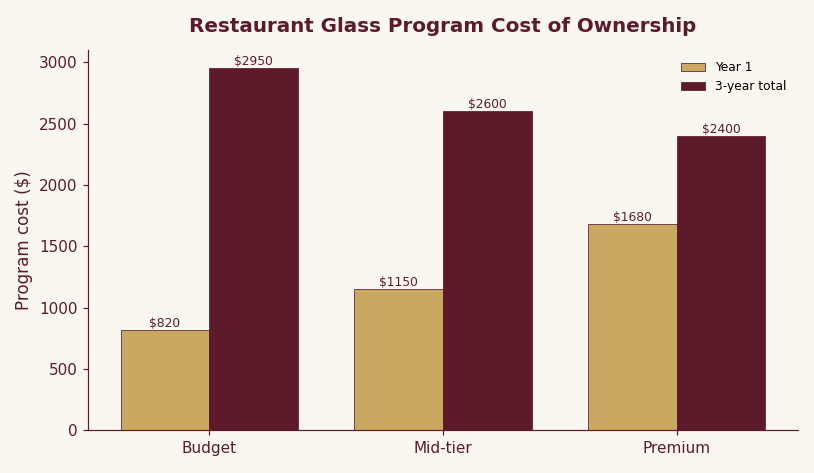
Here is the calculation every beverage program should run once a year, shown for a 120-seat full-service restaurant stocking 300 wine glasses.
| Program | Cost per glass | Annual breakage rate | Glasses replaced/yr | Annual replacement cost |
|---|---|---|---|---|
| Budget catering-grade | $3.75 | 85% | 255 | $956 |
| Mid-tier tempered, reinforced rim | $7.50 | 40% | 120 | $900 |
| Premium commercial, pulled stem | $11.50 | 22% | 66 | $759 |
Read that last column again: the premium glass is the cheapest program to run, and the gap widens once you add freight on frequent reorders and the soft costs of rack gaps and mismatched replacements. Purchase price is a one-time number; breakage rate compounds every month you operate.
One Shape or Three? The Program Question
Varietal-specific stemware is a pleasure in fine dining, but every additional shape multiplies your par stock, rack types, and reorder complexity. For most full-service concepts, the durable answer is one excellent universal glass for the core list plus a single larger bowl for premium reds. Catering operations and event venues should go further and standardize on one shape entirely — when 400 glasses come back on carts at midnight, uniformity is durability.
Branding Without Breakage
Etched logos and custom marks do not weaken a properly tempered glass — etching removes microns from the surface, well inside the compression layer. What matters is placement: keep etching off the rim area and upper bowl flex zone, and specify it low on the bowl or on the foot. A subtly etched house mark also has a practical benefit no one advertises: branded glassware walks out the door far less often than plain stemware, and shrinkage is a real line in the breakage budget.
Choosing a Partner, Not Just a Glass
The right restaurant wine glasses are a spec, a rack plan, and a reorder relationship. Look for a supplier who will quote replacement pricing and hold your pattern in stock — continuity is worth more than a discount on round one, because the mismatched-glassware look costs you on every table turn. We keep house patterns on file precisely for this reason; read about our process on the about page, see more operator guides on the blog, or get in touch to talk through your program. If your venue also hosts weddings, our guide to wedding toasting glasses covers the keepsake side of event glassware.
Run the math on your own numbers before the next reorder. In stemware, as in most operating decisions, the cheap option and the low-cost option are rarely the same glass — and the difference shows up every single year you keep the doors open.
Stemware that survives the dish pit — and the math.
Commercial-grade wine glasses, custom etching, and replacement pricing held on file for your pattern.
Leave a Reply